

In 2026 a virtual CIO costs a small business about $1,500 to $3,000 a month as an MSP retainer, $8,800 to $13,000 for a part-time fractional CIO, or nothing extra when strategy and roadmapping sit inside a managed IT agreement. At VJNetworks it sits inside the agreement, and larger companies that need dedicated vCIO work typically start around $1,995 a month.
Those are not three prices for one product. They are three different purchases that share a job title, and most of the confusion around vCIO cost comes from lining them up as if they were interchangeable. Easy mistake to make.
One is a person. One is a slice of a person. The third is a function, handled by the company already running your IT.
So which one is yours? It has less to do with the title than with how big you are and who is already on staff. Below is how each is priced, where the published market numbers come from, and how our own vCIO strategy and roadmapping is priced for businesses in Rockland, Westchester, and Bergen.
What You Are Actually Buying
A virtual CIO, or vCIO, is an outside technology leader who does the planning half of a chief information officer’s job for a company that does not employ one. That means a multi-year roadmap, an IT budget forecast, hardware and software lifecycle tracking, and vendor renewals, delivered part time or as a shared resource.
Notice what is missing from that list. Tickets. Password resets. The printer. A vCIO decides what the business should buy and when, and somebody else does the daily support. Often the same company. Not always.
The market sells the function three ways.
- Inside a managed IT agreement, where the same provider that supports your users also builds the plan. No separate invoice line.
- As a monthly retainer, usually from a managed service provider, billed on its own.
- Through a fractional CIO, an independent executive hired for a fixed number of hours a week, often for a project with a start date and an end date.
A fourth option belongs in the comparison too. Hiring a full-time CIO or IT director is the number everything else gets measured against, so it gets its own section further down.

What Each Option Costs in 2026
The table below puts the four options side by side, monthly, with the source for each figure. None of the market rows are VJNetworks prices. Ours is the last row.
| Option | Typical monthly cost | Source |
|---|---|---|
| Full-time in-house CIO, one dedicated employee | About $20,850 loaded (median salary $175,140 a year) | BLS, May 2025 wages and June 2026 benefit costs |
| Fractional CIO, about 13 hours a week | $8,800 to $13,000 | Go Fractional, October 2026 |
| vCIO retainer from an MSP, 50 to 200 users | $3,000 to $8,000 | Scopable, April 2026 |
| vCIO retainer from an MSP, 10 to 50 users | $1,500 to $3,000 | Scopable, April 2026 |
| VJNetworks managed IT, with vCIO strategy and roadmapping included | From $995; dedicated vCIO work for larger companies typically starts around $1,995 (estimate) | VJNetworks |
Plot the market rows on one axis and the pattern is hard to miss. Every part-time option costs less than the full-time hire. The retainers cost a small fraction of it.
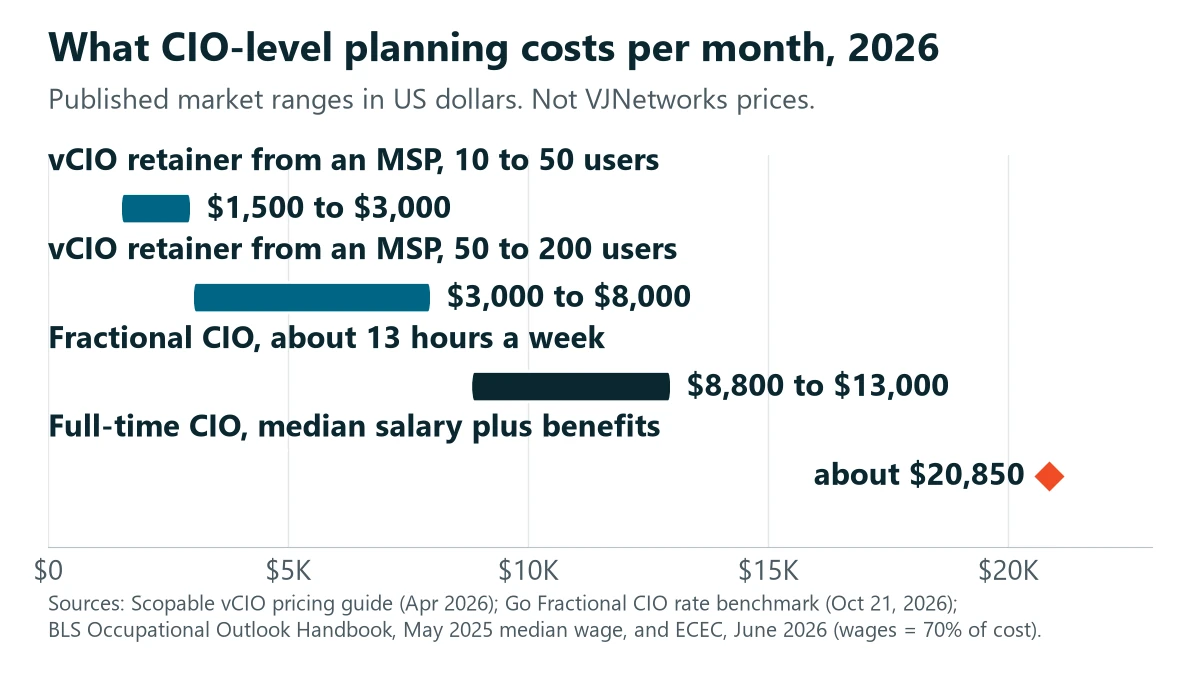
Read the sources before you lean on any single figure. The fractional numbers come from Go Fractional’s fractional CIO rate benchmark, a marketplace that publishes a rolling 90-day view of posted and asking rates. As of October 21, 2026 it showed a middle band of $170 to $250 an hour, a $208 average, and about 13 hours a week as typical scope. The sample was small, six job posts and 157 candidate profiles, and the site says there is not yet enough CIO-specific data to set the weekly hours for this role alone. Small sample, then.
The retainer bands come from a 2026 vCIO pricing guide from Scopable, which sells quoting and planning software to MSPs and wrote the guide for MSP owners deciding what to charge. It also lists $200 to $300 an hour as the usual US hourly rate for vCIO advisory work. Those are reference rates, not a survey of invoices.
Useful for scale. Not a quote.
The Full-Time Number, and What It Buys
The Bureau of Labor Statistics groups CIOs with other computer and information systems managers. According to the BLS Occupational Outlook Handbook, the median annual wage for that group was $175,140 in May 2025, with the lowest 10 percent under $107,550 and the highest 10 percent above $297,510.
Salary is not the whole cost. The BLS Employer Costs for Employee Compensation release for June 2026 puts wages at 70.0 percent of what private employers spend per employee hour, with benefits making up the other 30.0 percent. Divide the median salary by 0.70 and a full-time hire lands at roughly $250,000 a year, or about $20,850 a month, before recruiting fees. Every single year.
That median covers employers of every size, many of them far larger than a 30-person office. A small business might hire for less. It will rarely hire for a tenth of that.
The money does buy something. One person who knows your business deeply, works only on your problems, and is in the building. For some companies that depth is worth every dollar. At a company of 5 to 60 people, though, the planning load rarely fills a full-time week, and paying for forty hours to get six is an expensive way to buy a roadmap.
How VJNetworks Prices vCIO Work
vCIO strategy and roadmapping is part of our managed IT agreements. It sits on the same list as unlimited support, endpoint security, network maintenance, and help meeting compliance goals, and it does not show up as its own line on the invoice. No separate contract, either. Managed IT starts at $995 a month, and the full managed IT cost breakdown for Rockland, Westchester, and Bergen walks through where most offices land above that floor.
Some companies need more than the planning that comes with a standard agreement. They are larger, and the strategy work takes real hours every month. For those engagements, my starting estimate is around $1,995 a month. When I was asked for a number while we were planning this guide, this is how I put it.
“I’d say VCIO would start at, like, 1995 a month, maybe. ‘Cause a company that’s gonna get that isn’t gonna be a five person company. They’re gonna be bigger.”
Note the “maybe.” It is a starting point, not a rate card.
Pricing for that work scales with two things, the size of the company and whether it already has internal IT staff, so the number for a specific business comes out of a conversation about that business.
Why Size Moves the Price
Planning work grows with the thing being planned.
A 12-person office with one site, one internet circuit, and a dozen laptops has a short roadmap. A few replacement dates, a licensing renewal, maybe a firewall subscription. A company four times that size has more of everything, and every item on the list touches more people when the timing is wrong. Server replacements, second locations, a line-of-business application with its own upgrade calendar, a lease that ends in the middle of a hardware refresh. Each one is a decision someone has to model, price, and schedule. Miss one, and it shows.
Internal IT changes the shape of the work. If you already employ an IT person, they handle the daily load, and the vCIO side becomes a planning partner for them rather than a replacement for anything they do. Their week stays theirs. That is a co-managed arrangement, and we scope it around the team you already have.
Then there is the five-person office. Honestly? A separate vCIO engagement there usually costs more than it saves. The planning that business needs fits comfortably inside the managed agreement, and the money is better spent elsewhere. Our guide to what a 20-employee business should budget for IT shows where the rest of that budget tends to go.
What the Work Should Produce
A vCIO is worth paying for only if something written comes out of it. At minimum you should be able to point to these.
- A roadmap that names what gets replaced, upgraded, or retired, and roughly when.
- A budget forecast you see before your fiscal year starts, not invoice by invoice.
- A running lifecycle list. Warranties, end-of-support dates, the machines that are on borrowed time.
- Vendor renewal dates in one place, so a contract does not auto-renew because nobody remembered it.
- Technology decisions checked against your compliance and cyber insurance obligations before you make them.
No document, no plan.
On cadence, I would push back on the idea that more meetings add more value. Most of this work follows the business’s own calendar. Budget season. A lease renewal. A hiring plan. For most small businesses, a full planning session once a year is closer to reality than anything more frequent, with contact in between whenever a decision comes up.

Security strategy is a separate job. A vCIO plans technology and budget; a virtual CISO owns security risk, policy, and the compliance program. People mix them up constantly. If that is the role you are really shopping for, our vCISO service page explains where one ends and the other begins.
When a Retainer or a Fractional CIO Is the Better Buy
Bundled planning is not the right answer for everyone, and I would rather say so here than in a sales meeting.
A standalone vCIO retainer makes sense when you are happy with whoever handles your support and simply want a separate strategic voice. Some owners like that split. It works.
A fractional CIO is built for a different situation. You are replacing an ERP system, merging with another firm, or building an internal IT department from scratch, and you need an executive inside the business for a day or two every week until it is done. Then they leave. At $8,800 to $13,000 a month for about 13 hours a week, that is still a fraction of the full-time number, and the engagement can end when the project does.
And if you already have a capable IT director doing the planning? You probably need neither. Layering an outside vCIO on top of a strategy someone on staff already owns adds cost without adding much, and we would tell you that up front.
Questions Owners Ask Before They Budget for It
Is vCIO strategy an extra charge on a VJNetworks managed IT agreement?
Why would a 40-person company pay more for the same title than a 10-person one?
We already employ an IT person. Does that change what vCIO work costs?
Fractional CIO or vCIO retainer, which suits a growing business?
How often should a vCIO actually sit down with us?
Would a small business really pay $175,140 for a full-time CIO?
Talk with our team about vCIO strategy and roadmapping and what it would look like at your size. No cost, no obligation.