
Cybersecurity for Small Businesses in Rockland, Westchester & Bergen
The cybersecurity your small business actually needs — without the enterprise jargon, the inflated package pricing, or the fear-based sales pitch.
Get Your Free Cybersecurity Assessment →
Cybersecurity for small businesses is the set of controls — multi-factor authentication, endpoint protection, email security, tested backups, and security awareness training — that prevents the vast majority of attacks targeting businesses with 5 to 60 employees. VJNetworks provides managed cybersecurity across Rockland County NY, Westchester County NY, and Bergen County NJ, led by a team with 20+ years of hands-on cybersecurity experience and HIPAA-compliant operating practices.
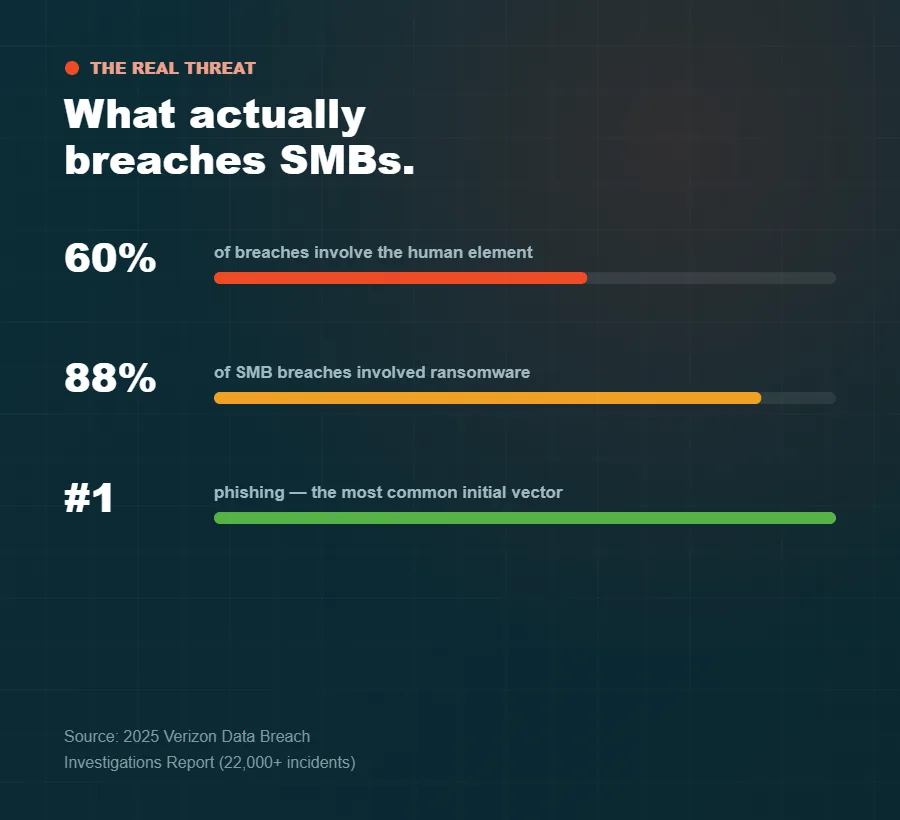
The real threat isn’t what the vendors keep telling you.
You’ve probably seen the pitches. Nation-state actors. Zero-day exploits. Advanced persistent threats. None of that is why small businesses actually get breached.
VJNetworks provides managed IT for small businesses across the Tri-State area, and cybersecurity is built into every engagement we run. According to the 2025 Verizon Data Breach Investigations Report — which analyzed more than 22,000 security incidents — 60% of breaches involved the human element, and phishing was the most common initial attack vector. The same report found ransomware appeared in 88% of SMB breach incidents.
The actual threat landscape for a small firm in Rockland or Bergen County looks like this: a staff member clicks a convincing email link and hands over their credentials. A former employee’s account stays active two weeks after they leave. A backup nobody has tested in 14 months turns out not to work. Ransomware encrypts the accounting folder on a Tuesday afternoon.
These aren’t sophisticated attacks. They succeed because the basics aren’t in place — and fixing the basics is what VJNetworks actually does. Most clients don’t need a $50,000 enterprise security stack. They need the eight or ten controls that close 90% of their real exposure, deployed correctly and maintained by someone who already knows their systems. What that actually runs is a fair question, and we answer it layer by layer in our guide to small business cybersecurity pricing.
What cybersecurity for a small business actually includes.
A business with 5 to 60 employees doesn’t need a military-grade security architecture. It needs specific controls applied consistently. Every environment is different, but the foundation looks like this.
Multi-Factor Authentication on Everything
Every account — email, remote access, line-of-business apps. The 2025 Verizon DBIR links credential theft to 22% of breaches. MFA stops the attacks where stolen passwords are the entry point, and that’s most of them. For remote staff specifically, see zero trust vs VPN for which approach actually secures that access.
Modern Endpoint Protection (EDR-Class)
Antivirus from 2018 is not endpoint protection. EDR watches behavior, not just signatures. If something runs that looks like ransomware, it’s terminated and rolled back before the encryption spreads.
Email Security with Phishing Detection
Email is the delivery vehicle for most attacks, including business email compromise. Phishing filters, link scanning, and DMARC/DKIM/SPF authentication are the baseline. Security awareness training on top is what actually changes behavior.
Backup with Tested Restore
A backup nobody has tested is an assumption. We verify restores actually work, on a schedule, before a client needs them. Cyber insurers now require documented backup testing — it isn’t optional if you want to stay insurable.
Patching on a Defined Schedule
Unpatched software is an open door. We manage patches across workstations, servers, and network equipment — including managed firewall and network security — on a consistent schedule. The 2025 Verizon DBIR found exploitation of vulnerabilities jumped 34% year-over-year.
Documented Employee Offboarding
The account that stays active after someone leaves is a real, common risk — a core part of identity and access management. Documented offboarding — account deprovisioning, email forwarding removal, MFA token revocation — closes the gap IT often misses in a rushed transition.
Security Awareness Training
People are the target. Training doesn’t eliminate risk but it changes the odds. We work with small businesses on ongoing training that’s practical — not a once-a-year checkbox exercise.
Cyber Insurance Documentation
What used to be a one-page questionnaire is now a documented security posture review. We help clients document controls in a format that supports coverage eligibility and favorable terms at renewal — our cyber insurance renewal checklist covers what carriers ask for now.
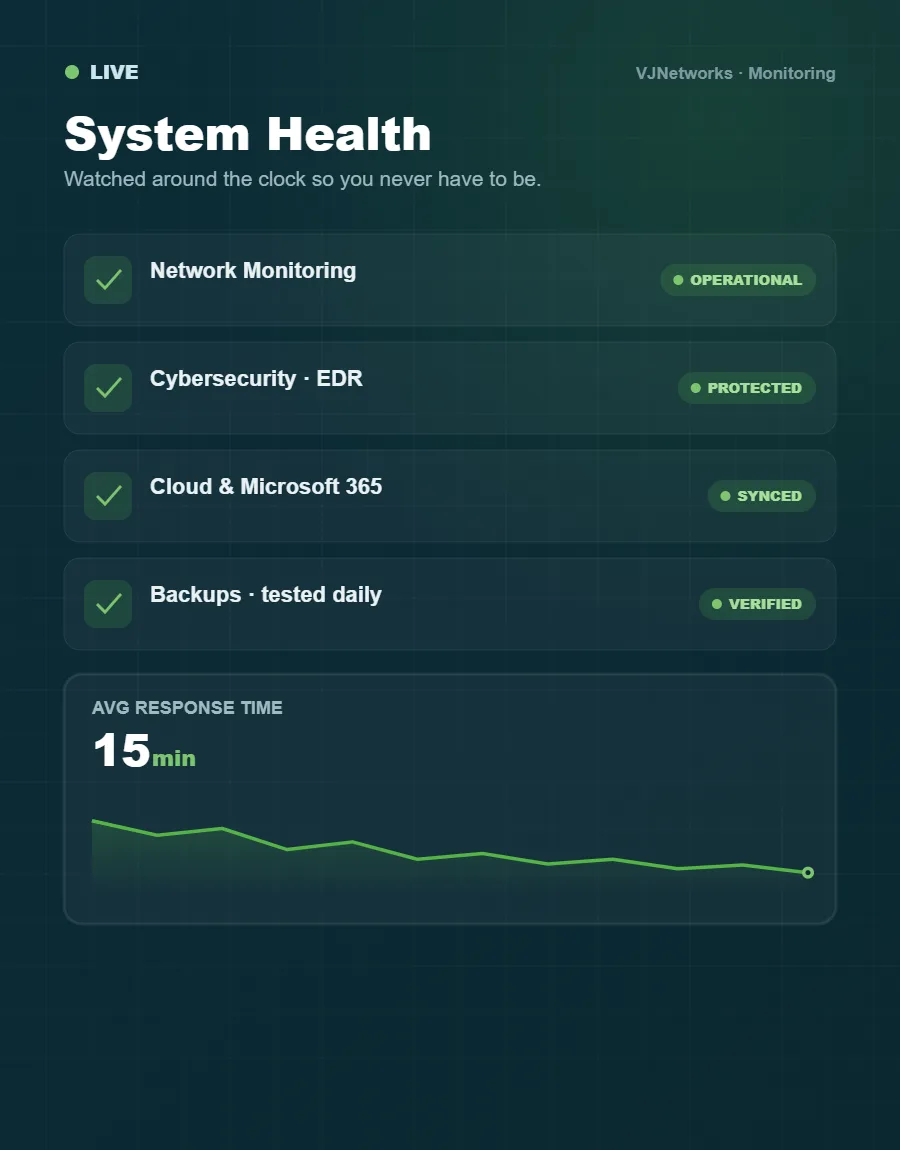
The configurations we deploy are reviewed by someone who’s done this for 20+ years.
Monitoring catches the behavior. But the controls behind it — what gets deployed, how it’s configured, what gets flagged as a real risk versus noise — are reviewed by Mike Stoveken, who’s worked across both SMB and enterprise environments.
That’s the difference between a security stack that looks complete on paper and one that actually closes your exposure.
Every MSP uses these terms. Most don’t explain them.
Here’s what they actually mean — and what they mean for a business your size.
MFA — not the others — is what most small businesses should deploy first. The rest follows from the risk profile of the specific environment.
Where VJNetworks stands on compliance.
Some industries have specific requirements that go beyond general cybersecurity hygiene.
HIPAA-Compliant Practices
We operate under HIPAA-compliant practices. For organizations handling protected health information, our team follows the administrative, physical, and technical safeguard requirements for how patient data is accessed, handled, and protected.
FTC Safeguards Rule
For accounting and financial services firms, the FTC Safeguards Rule under Gramm-Leach-Bliley now requires a written information security plan. We help clients document controls in a format that satisfies those requirements.
Cyber Insurance Documentation
Carriers now want screenshots, policies, logs, and evidence of backup testing. We keep that documentation current as part of ongoing managed service — not as a one-time fire drill before renewal.
Security built around how your industry actually works.
Accounting & CPA Firms
Tax season is the worst possible time for a systems failure. We work with accounting firms in Rockland and Westchester who need IT that holds up under deadline pressure and handles sensitive financial data correctly. Several of the CPA firms we support have been clients for years.
Healthcare Practices · since 2008
HIPAA compliance isn’t optional. We manage security controls that keep patient data protected and audit documentation current. When built correctly, it doesn’t create friction — it just runs.
Professional Services Firms
Consultancies, insurance agencies, and financial services firms handle sensitive client data and face increasing scrutiny from cyber insurers. The controls we deploy are the same ones underwriters check at renewal.
Multi-Location Businesses
Inconsistent security across locations is a gap — an endpoint at a satellite office with an older configuration is a way in. We standardize security controls across every location a client operates, managed centrally.
We’d rather help you find the right fit than oversell.
You need a fully staffed security operations center with dedicated analysts watching in real time. That’s a different category of service, and we’ll tell you that honestly rather than oversell what we offer.
If your business is above 100 employees, there are providers purpose-built for that scale. We’d rather help you find the right fit than sell you a service that doesn’t match your needs.
Compliant
Four steps. No months-long sales process.
Free Cybersecurity Assessment
We review endpoints, email, backup, MFA, user access, patch status, and offboarding as part of a full security risk and vulnerability assessment. You get a clear picture of where you stand — no jargon-heavy report you need a translator for.
Findings & Recommendations
We walk you through what we found in plain English. Not every recommendation is urgent — we’ll tell you what’s a genuine risk and what can wait, and why.
Onboarding & Implementation
If you move forward, we handle implementation. New clients are onboarded usually within a week — documentation, monitoring, and controls all in place before the end of the first month.
Ongoing Managed Cybersecurity
Threats change, employees come and go, new systems get added. We monitor, patch, test backups, and review access on an ongoing basis. When your insurance renewal comes up, your documentation is already ready.
About small-business cybersecurity.
What cybersecurity does a small business with 20 employees actually need?
Start with MFA on every account, modern endpoint protection (EDR-class), email security with phishing filtering, tested backups, and a documented offboarding process. Those five controls close the vast majority of real exposure for a firm your size. Security awareness training adds a meaningful layer on top. Most small businesses don’t need a dedicated security operations center or enterprise-grade detection infrastructure — they need the fundamentals applied correctly and maintained consistently.
Do small businesses really get targeted by cyber attacks?
Yes, and the targeting is getting more deliberate. Phishing accounts for 33.8% of SMB breaches according to 2025 data. The 2025 Verizon Data Breach Investigations Report found ransomware appeared in 88% of small business breach incidents. The reason small businesses get hit isn’t that attackers specifically want your data — it’s that the barriers are lower. A business without MFA, with stale patches and untested backups, is a more efficient target than a large company with a security team.
How much does cybersecurity for a small business cost?
Most of our clients in the $2,000/month managed IT range have cybersecurity controls built into their managed service agreement. Standalone assessments are available. The more relevant comparison: a ransomware recovery for a business our size typically runs $50,000 to over $100,000 in direct costs, not counting business interruption, lost revenue, and the time it takes to rebuild systems. Cyber insurance premiums have also climbed significantly, and businesses without documented controls face coverage denial or premium increases that dwarf what managed security costs per month.
Why do you say that frequent password changes hurt security?
Because the research says so, and NIST agrees. NIST Special Publication 800-63B, the federal standard for digital authentication, prohibits periodic password rotation as a mandatory policy. Revision 4, finalized in 2024, is explicit: forcing users to change passwords on a schedule pushes them toward predictable patterns — slight variations of the previous password that attackers model and can guess. What works instead is longer passwords or passphrases, mandatory breach detection against known compromised credential lists, and MFA layered on top. We change this policy for every client we onboard.
Do you provide security monitoring?
VJNetworks monitors your environment and responds when needed. We provide proactive monitoring, immediate response during business hours, and documented escalation procedures for after-hours incidents. For most small businesses with 5 to 60 employees, that matches the actual risk profile.
What happens if we get hit with ransomware?
We have documented incident response procedures and have handled ransomware recovery before. The first steps are containment and isolation — stopping the spread before the encrypted scope grows. Then assessment, recovery from clean backups, and a post-incident review to close whatever entry point was used. The businesses that recover fastest are the ones with tested backups and documented recovery procedures already in place.
Does cyber insurance require specific security controls?
Requirements tightened significantly in 2025 and 2026. Carriers now want documented evidence, not just checkboxes on a questionnaire. Screenshots of MFA enrollment, patch compliance reports, backup restore logs, and a written incident response plan are common requirements. VJNetworks maintains this documentation as part of ongoing managed service — so when your renewal comes up, you have everything ready.
A breach at a business your size costs between $120,000 and $1.24 million, according to the Verizon Data Breach Investigations Report — and that’s before lost client trust and insurance complications.
Most of what we fix for new clients had been there for years — password policies that made security worse, backup systems nobody had tested, accounts still active for people who left the company eight months ago.
The assessment is free. You’ll know exactly where you stand.
If you’re not happy in the first 90 days, we tear up the contract. No fight, no hassle.