
A VPN vulnerability is a flaw in the software that runs a VPN, such as a firewall’s. CISA lists many that attackers have exploited. Each one below was fixed by a vendor update, not by dropping the VPN.
Firewall updates lag. Tenable studied the edge-device flaws featured in Verizon’s 2025 breach report, and for two flaws in Fortinet’s FortiOS, the average time to fix ran from 172 days to more than 260 days, depending on the industry. Months, not days.
We manage firewalls for clients, and our page on managed firewall and network security covers how. This piece sticks to one question. Which updates slip, and where? The evidence comes from flaws that CISA, the federal cyber agency, has logged as exploited, and from the vendors’ own documentation.
What a VPN Vulnerability Looks Like on a Small Office Firewall
A VPN vulnerability is a software flaw in the part of a firewall that accepts remote connections, such as the VPN login service. Remote staff reach that service over the internet. So can an attacker. CISA’s catalog describes two of the flaws below as usable by a remote attacker with no login at all. The Cisco flaw needs valid VPN credentials, according to the National Vulnerability Database, and CISA notes it could be chained with a second Cisco flaw.
Different vendors, same shape. The table pulls four flaws from CISA’s Known Exploited Vulnerabilities catalog, a list of flaws attackers are confirmed to be using, and we read each entry on November 9, 2026. Each was fixed in newer versions of the vendor’s software.
| Flaw | Where it lived | Added to CISA’s list | Ransomware use, per CISA |
|---|---|---|---|
| CVE-2022-42475 | Fortinet FortiOS SSL-VPN | December 13, 2022 | Known |
| CVE-2024-21762 | Fortinet FortiOS | February 9, 2024 | Known |
| CVE-2024-40766 | SonicWall SonicOS, management access and SSL VPN | September 9, 2024 | Known |
| CVE-2025-20333 | Cisco ASA and Secure Firewall Threat Defense, VPN web server | September 25, 2025 | Unknown |
Three of the four carry CISA’s flag for known use in ransomware campaigns. Tenable reports that ransomware groups including Fog and Akira used the SonicWall flaw “to gain initial access to their victims’ networks.” The Cisco flaw was one of two named in an emergency directive CISA issued on September 25, 2025.
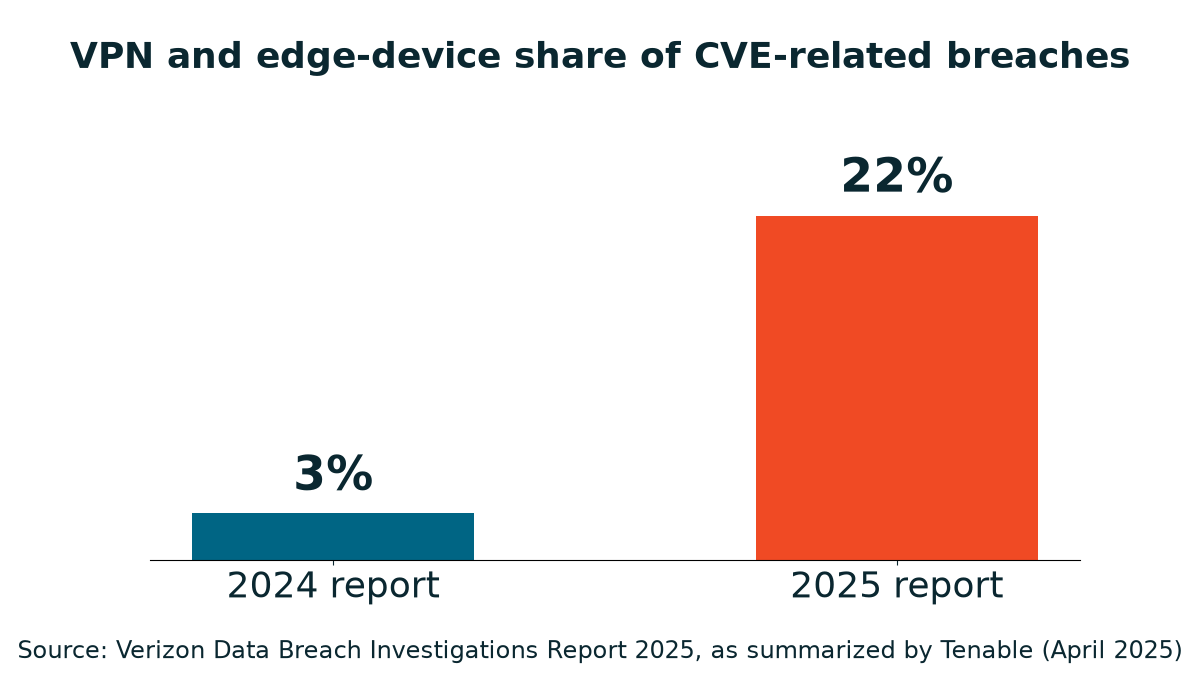
Verizon’s 2025 Data Breach Investigations Report put a number on the wider trend. As Tenable summarized it, VPNs and other edge devices accounted for 22% of the CVE-related breaches in that year’s report, almost eight times the 3% in the report before.
Why Firewall Updates Lag
Start with the restart. On Meraki’s MX firewalls, “All firmware upgrades will require that the MX appliance reboots,” and Meraki’s firmware best-practice guide warns that the upgrade “will take down the entire local network in most scenarios.” Fortinet’s administration guide says a FortiGate installs the new firmware and restarts. That takes a few minutes. Meraki’s exception is a pair of MX appliances set up for high availability, which the dashboard upgrades one at a time “to ensure a zero-downtime MX upgrade.”
Then there’s the schedule. Meraki notifies administrators one to two weeks before an automated upgrade, runs it in the configured maintenance window, and lets it be moved to a different day or time if needed. Useful flexibility. Meraki also says some networks “might not get a firmware upgrade scheduled due to various reasons,” and it recommends that administrators check their networks periodically and upgrade manually when that happens.
Five Places to Check for VPN Vulnerability Exposure
The firmware on the firewall itself
Firmware is the appliance’s operating system. The VPN runs inside it. The flaws in the table sat in FortiOS, in SonicOS’s management access and SSL VPN, and in the VPN web server of Cisco’s ASA and Threat Defense software, and each was closed by newer versions of that software. SonicWall’s advisory for its flaw is plain about it: “Please apply the patch as soon as possible for affected products.”
The firewall at the other site
A second office with its own firewall is a second device to update. Meraki runs its MX firewalls on “a one-dashboard-network per-site model,” which it says gives granular control over how upgrades are managed across a deployment. Per site cuts both ways. Headquarters can be current while the branch is not, and a site-to-site VPN connects the branch’s network to the main one.
A box the vendor no longer supports
Once a device reaches end of support, CISA’s definition says, it no longer receives timely, supported updates from its manufacturer. SonicWall’s advisory says its older end-of-life units affected by this flaw “are susceptible to this exploit and there will not be a software update released for these out-of-support units.” No update means no fix. CISA’s Binding Operational Directive 26-02, issued February 5, 2026 for federal agencies, says the agency is “aware of widespread exploitation campaigns by advanced threat actors targeting EOS edge devices,” where EOS means end of support, and its definition of edge devices includes firewalls. Read the full directive for the reasoning.

The vendor notice and who gets it
Meraki sends its upgrade notices to administrators, one to two weeks before a scheduled upgrade. If the only administrators listed are a former IT provider or an employee who has left, the notice never reaches anyone in the office. Renewal dates need the same kind of owner, and our guide to what stops working when a firewall’s security subscription lapses shows where each platform displays them. Check whose inbox it is.
The look after the update
Patching closes the flaw from that point on. It doesn’t show whether someone used the flaw before the patch landed. In its April 2026 update to Emergency Directive 25-03, CISA said that applying the Cisco-provided security updates “does not necessarily remove an existing threat actor from the compromised device.” SonicWall asked for more. Its advisory strongly recommends that users of its Gen 5 and Gen 6 firewalls with locally managed SSL VPN accounts change their passwords, and it recommends multi-factor authentication for all SSL VPN users.
How to Fix a VPN Vulnerability Without Replacing the VPN
The fix for each flaw in the table was newer software from the vendor. Not a new VPN. For most businesses running three to ten sites, a well-configured site-to-site VPN mesh is still fine, which is where we landed in our look at VPN or SD-WAN at your size.
So keep the VPN. Keep the firewall under it current. Four questions are worth putting to whoever looks after yours this week.
- Which firmware is each firewall running, at every site, and is that version still supported?
- Who receives the vendor’s security and upgrade notices?
- When was the last update applied, and by whom?
- Does any firewall in the company sit on hardware the vendor has stopped supporting?
Those answers belong in a security baseline, a written snapshot of what protects the business today. It’s the first step in the IT roadmap for a small business we’ve laid out, and it starts by counting what is actually in the building, down to the network closet.
Where Patching Sits in a VJNetworks Agreement
Network security and network maintenance are part of our managed IT agreement. Our managed IT service lists firmware among the things we maintain, and under our managed firewall service we deploy, patch, configure and monitor the firewall on an ongoing basis. VJNetworks has provided managed IT services since 2004.
Which firewall? Mike Stoveken, our Vice President, ranks Cisco Meraki, FortiGate and SonicWall among the top platforms. Hardware isn’t included. Anything outside the agreement gets discussed first. In Mike’s words: “We would discuss these things with you before we did any of them.”
Already have someone in-house? A co-managed scope can be built around exactly what you ask for, for example the network equipment, servers, Microsoft 365, backups and patches, while your own IT person keeps the workstations and user support. You decide where the line sits.
Things People Ask About Firewall and VPN Updates
Will updating the firewall knock the office offline?
We have a support contract. Doesn’t that mean we’re patched?
How do I find out whether a flaw affects my firewall?
We patched last month. Are we in the clear?
Should we scrap the VPN?
Is an old firewall that still works really a problem?
Talk with our team about your firewall, its firmware and who receives the vendor’s security notices. No cost, no obligation.
If you are evaluating your overall network protection, see our comparison of managed firewall providers in the Tri-State area.