

Managed IT cost for an insurance agency starts at $995 a month with VJNetworks. Where you’re starting from and how many people sign in move the number from there.
Before you compare quotes for agency IT, find out what each one includes. Microsoft licenses? Hardware? Ask, line by line.
This guide is for the principal or office manager of an independent agency in Rockland, Westchester, or Bergen, the reader our page on managed IT for insurance agencies and brokers is written for. It sets out the bill one line at a time, so that when two quotes land on your desk in the same week you can hold each one against the same list and see what’s missing.
One limit first. The price ranges that show up when you search for agency IT costs come from companies selling the service, and we found no neutral price list. So the figures here come from Microsoft’s published price, the text of New York’s cybersecurity regulation, and our own starting price. Where a number would only be a guess, we left it out.

Managed IT Cost for an Insurance Agency: Where the Number Starts
Managed IT is a monthly fee for someone else to support your staff, secure your computers and network, and manage Microsoft 365. For an agency it is one slice of the technology spend, not all of it. Our agreements start at $995 a month.
Four more lines sit around that fee. Who sends each invoice matters as much as the amount.
| Line and who bills it | Reference figure | What moves it |
|---|---|---|
| Managed IT agreement, billed by VJNetworks | From $995 a month | Headcount and what is already in place |
| Microsoft 365 seats, billed as the quote is built | $22.00 per user a month, annual term (Business Premium list price) | Number of users |
| Agency management system, billed by its vendor | Set by the vendor | The vendor’s own terms |
| Hardware, bought separately | Not in the agreement | Laptops, switches, the firewall |
| Legal advice or a compliance officer, from your counsel or a compliance firm | Outside our agreement | Whether and how Part 500 reaches you |
Look at the figure column. One price is ours, one is Microsoft’s, and the other three cells hold no dollar amount at all. That’s on purpose. A software vendor’s price is the vendor’s, hardware depends entirely on what you buy and when you buy it, and legal or compliance fees aren’t ours to guess at, so any number we invented in those cells would come back to us as a promise.
What the Managed IT Fee Covers, and What It Doesn’t
Here is what an agreement of ours covers.
- Unlimited support
- Endpoint security, plus monitoring and advisement on it
- Management and security for the platform we run for you, typically Microsoft 365
- Network security and network maintenance
- Repairs
- Help meeting compliance goals
- A hand in onboarding and offboarding staff
- vCIO strategy and roadmapping
Left out: materials, hardware, and toner. A new switch or a replacement laptop is its own purchase, and so is software licensing beyond what we manage under contract.
Endpoint security sits inside the agreement with no separate price. A quote that itemizes it can’t be set against ours line for line.
Nothing outside the agreement gets billed without a conversation first. Mike Stoveken puts it this way: “You’re not gonna get a surprise bill for something that you didn’t approve of.” What the contract leaves out is laid out in what an IT contract doesn’t cover.
Why Two Agencies Get Different Quotes
Mike was asked what it costs an agency to get compliant with rules like New York’s DFS cybersecurity regulation. He named no number. He gave a reason instead. “Cost really comes down to their starting point. What do they have implemented already, what do they need, and also the size.”
Then came the line that surprises people. “If you’re a one-person agency and you have nothing, it’s probably still going to cost you less than if you’re a 20-person agency and you have most of it already.” Read that twice.
It was an answer about compliance work, and he attached no dollar amount to it. We borrow the logic anyway, with that limit in plain view, because a monthly fee can’t be priced until somebody has looked at what’s already running, what’s missing, and how many people depend on it. So we start with questions. What do you run today? What’s in place? The number comes last.
Seats and the Microsoft 365 Line on an Agency’s Bill
This price is Microsoft’s, not ours. Business Premium is $22.00 per user per month on an annual term, or $26.40 if you pay month to month, according to Microsoft’s Business Premium plan page. The same page lists Microsoft Defender for Business and Intune device management among what’s included, and it describes the plan’s identity and access management as “for up to 300 users.” Those were the prices shown on November 13, 2026. Prices on that page can change, so confirm before you budget.
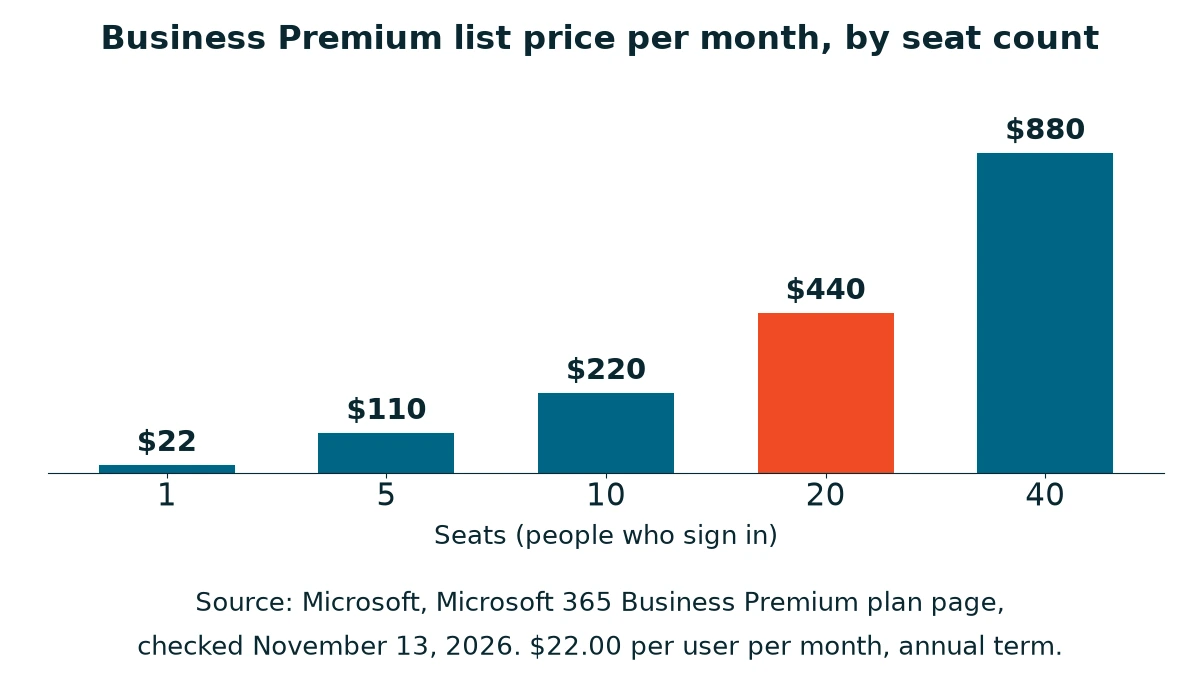
Do the multiplication and a single seat is $22, twenty seats are $440, and forty are $880. If one provider folds that into its monthly fee and another bills it beside the fee, the two quotes read nothing alike even though the list price underneath never moved. Ask each provider to break the seat line out.
Business Premium is priced per user, not per desk. A part-time producer who signs in to check email twice a week is a user. So is a seasonal assistant.
What New York’s Part 500 Changes About an Agency’s IT Cost
Mike raised the question that matters here. “It says insurance companies, but does that include insurance brokers?” The regulation answers it. Section 500.1(e) defines a covered entity as “any person operating under or required to operate under a license, registration, charter, certificate, permit, accreditation or similar authorization under the Banking Law, the Insurance Law or the Financial Services Law.”
The regulation itself refers to individual insurance agents under Insurance Law section 2103 and individual insurance brokers under section 2104, in its exemptions section. As we read the text, the definition reaches agents and brokers and doesn’t stop at carriers. That is our reading, not legal advice, and your counsel should confirm it for your agency.
One carve-out concerns agents. Under 500.19(b), an agent of a covered entity that is itself a covered entity is exempt “to the extent” the other entity’s cybersecurity program covers it. Whether a given carrier’s program covers a given agency is a question for counsel.
Size comes next. Under 500.19(a), a covered entity gets the limited exemption by meeting any one of three tests: fewer than 20 employees and independent contractors, less than $7,500,000 in gross annual revenue in each of the last three fiscal years, or less than $15,000,000 in year-end total assets, affiliates included. It’s “or,” not “and.” Our post on who Part 500 covers and what an agency has to file walks through the full list.
How the Limited Exemption Changes Three Requirements
| Requirement | Limited exemption | No exemption |
|---|---|---|
| Multi-factor sign-in (500.12) | Remote access to your systems and to third-party applications that reach nonpublic information, plus privileged accounts | Any individual accessing any information system |
| Encryption of nonpublic information (500.15) | Excused | In transit over external networks and at rest |
| Asset inventory (500.13) | Required | Required |
Scope drives the work. Multi-factor sign-in for three kinds of access is a narrower job than multi-factor sign-in for every person on every system. An inventory that tracks each asset’s owner, location, sensitivity, and support expiration date is a job in itself, and the limited exemption doesn’t excuse it, which is why that row reads the same in both columns.
The phase-in is over. Section 500.22 allowed two years from the 2023 amendment’s effective date for the new requirements in 500.12 and 500.13(a), and that amendment took effect on November 1, 2023, so the window closed on November 1, 2025. Our piece on the documents that prove each control covers the evidence side.
One more point for Bergen agencies. Part 500 attaches to New York licenses, not to where the office sits. As we read the definition, anyone operating under, or required to operate under, a New York insurance license is in scope, and an agency with no New York license and no need for one isn’t. Check which licenses your producers hold before you assume either way.
Encrypted Email, the Line Agencies Needed First
Mike has seen this one first-hand. Of the insurance brokerage clients he works with, he says “they were also the first ones who needed encrypted email.” The reason is the data. Agencies send personally identifiable information, and Microsoft says its message encryption “helps ensure that only intended recipients can view message content.”
On the Microsoft side, the Microsoft Purview service description lists Message Encryption as included with Business Premium. So on that plan the license isn’t a separate line. The work is setup. Microsoft’s Message Encryption page explains that administrators can define Exchange mail flow rules that encrypt messages automatically, and that users can also encrypt a message themselves from Outlook. Ask whether a quote covers that setup.
Part 500 speaks to it too. Section 500.15 calls for a written policy requiring encryption of nonpublic information in transit over external networks and at rest, and 500.19(a) excuses a limited-exempt agency from it, as the table shows. The exemption removes the requirement. It doesn’t remove the data. The mechanics are in how Microsoft 365 handles encrypted email.
Backup, Storage and Hardware: The Rest of the Bill
Backup is priced on its own logic. Mike’s line says it better than a price sheet could. “It isn’t really a per server cost. It’s really a space cost.” Software or service on one side, storage on the other, and the storage side grows with the data.
Most of our customers hold a few hundred gigabytes, maybe a terabyte. One holds 20 terabytes on a single server. That’s a different job from backing up 500 gigabytes, and it gets planned like one.

Workstations mostly don’t get backed up. We keep the data off them on purpose. Servers come first.
Then there’s the agency management system, which earns a question of its own. Does it run on a server in your back office, or does the vendor host it? If it runs in your office, that server is one more machine to patch, secure, and back up. If the vendor hosts it, the hosting sits on the vendor’s invoice. Find out which before anyone quotes you.
Hardware sits outside the agreement entirely: laptops, switches, the firewall. Each is a separate purchase, and each should land on your budget as one. Want wider numbers? Try managed IT pricing across Rockland, Westchester and Bergen. Comparing providers instead? See how IT support companies compare for insurance agencies in New York and New Jersey.
Before You Request a Quote
Is $995 what an insurance agency will actually pay?
Does the Microsoft 365 license come out of the managed IT fee?
If my agency is exempt, can I skip multi-factor sign-in?
Does Part 500 reach a New Jersey agency?
Is encrypted email an extra in Microsoft 365?
Will a one-person agency really pay less than a 20-person agency?
Next Steps
Talk with our team about what your agency runs now and what that does to the monthly number. No cost, no obligation.