
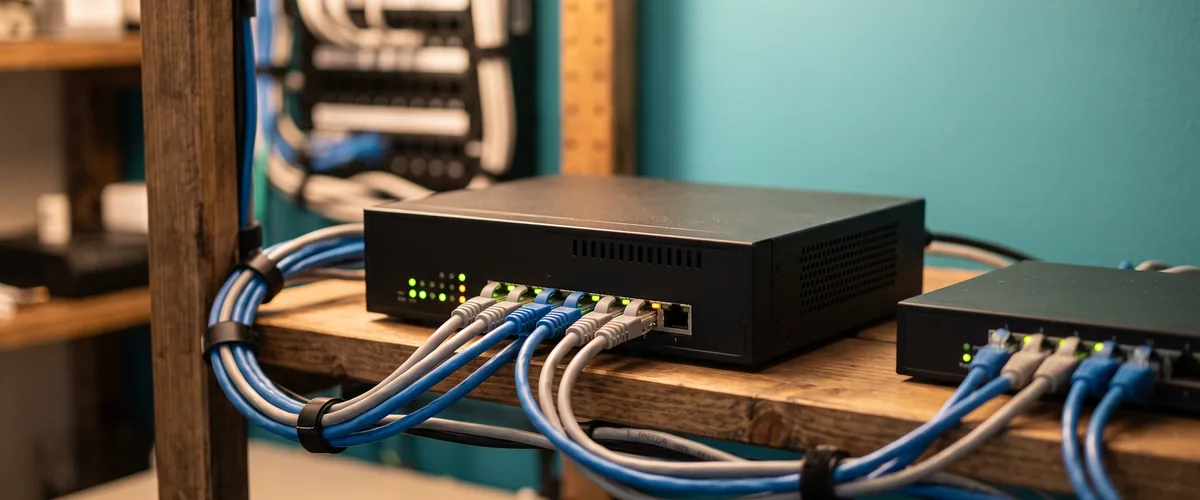
60% of enterprise firewalls fail high-severity compliance checks the moment they’re evaluated. Immediately. That’s from FireMon’s 2025 analysis across large enterprises and regulated industries.
If that’s the enterprise number, with dedicated security teams and seven-figure budgets, the small business number is likely worse. A 20-person professional services firm in Rockland doesn’t have a firewall engineer on staff. They have a firewall appliance that somebody configured three years ago, and nobody has touched the rule set since.
That’s the gap this article is about.
What a Cybersecurity Risk Assessment Actually Reveals About Your Firewall
A cybersecurity risk assessment isn’t a sales pitch. It’s a structured process: inventory every device and application on the network, identify what could target those assets, find the gaps, and rank them by how much damage each one would cause if exploited.
The firewall findings follow a pattern.
First, the rule set is bloated. FireMon’s data puts it at 30% of firewall rules completely unused across their customer base. That means nearly a third of the rules are dead weight. In a small business environment, the numbers are likely worse when nobody is auditing the rules at all.
Second, firmware is behind. SonicWall published a threat brief in September 2025 showing that misconfigurations drove 9.5 million cyberattacks in the first half of the year alone. Default passwords, exposed admin panels, authentication failures, vulnerabilities that have been patchable for years. Basic errors. And nearly 70% of organizations faced at least one authentication bypass attempt during that same period.
Third, the firewall is doing one job when it should be doing four. A modern next-generation firewall handles intrusion prevention, application-level inspection, VPN connectivity, and threat detection. A firewall that’s only filtering by port and protocol is a firewall from 2012.
A proper risk assessment surfaces all of this. It’s also a step toward NY SHIELD Act compliance, which I’ll get to later.
Managed Firewall vs. Self-Managed: The Real Decision for a Small Business
Before evaluating providers, there’s a more important question. Who’s managing it?
Buying a FortiGate appliance and plugging it in isn’t network security. It’s a start. The security comes from configuring the rules correctly, updating the firmware consistently, monitoring the logs for anomalies, and adjusting the policies as the business changes. That’s ongoing work. Somebody has to do it.
For a business with 5-60 employees and no dedicated cybersecurity staff, there are really two options.
Self-managed (in-house): You or your IT person handles everything. Configuration, updates, monitoring, incident response. The upside is full control. The downside is that it requires sustained expertise. Firewall rules accumulate and contradict each other over time. Firmware updates get deferred because nobody wants to risk downtime during business hours. Logs pile up unread. If your IT person leaves, the next person inherits a black box. And the cost isn’t just the salary. It’s the incidents that get missed because nobody was watching the logs.
Managed firewall (through an MSP or MSSP): A third party handles configuration, patching, monitoring, and rule management. The firewall appliance might sit in your office, but the expertise sits with a team that manages dozens or hundreds of firewalls and sees threat patterns across multiple environments.
For a business in Rockland, Westchester, or Bergen with no in-house security expertise, self-managing a firewall is the same trap as self-managing your entire IT. You can do it. The question is whether you should.
The Providers Worth Evaluating
I’m going to cover the platforms I rank at the top for a small business with 5-60 employees: Cisco Meraki, Fortinet FortiGate and SonicWall, in that order. There are enterprise platforms in this space that aren’t worth discussing for a company with two offices and 25 workstations.
Cisco Meraki (MX Series)
Cisco Meraki is primarily what we recommend and sell. If we had to pick one for the best security, my personal preference would be Cisco Meraki.
The MX is Meraki’s cloud-managed security and SD-WAN appliance, designed for businesses spread across locations that need remote administration. Cisco lists the MX67 and MX68 as small-branch appliances for up to 50 users, and the MX75 for up to 200.
Threat protection on the MX combines the Snort intrusion detection engine with AMP anti-malware, and the intrusion rules are curated by Cisco Talos and kept up to date from the Meraki cloud. Those features come only with the Advanced Security license edition, so check which edition a quote includes. All current Meraki products need valid licensing to operate.
For a business with more than one office, Meraki’s Auto VPN sets up site-to-site VPN between MX appliances from the Meraki dashboard, and the tunnels are established and maintained automatically.
Where it fits: Businesses that want their firewall managed from the cloud, and businesses with two or more offices that need a site-to-site VPN between them.
Fortinet FortiGate (40F/60F Series)
By Fortinet’s own count, FortiGate is the most deployed network firewall, with over 50% of global market share. The FortiGate-40F is an entry-level small business unit. What separates Fortinet is performance. Their custom ASIC chips handle inspection at the hardware level, so inspection is less likely to slow down your network the way software-based inspection can.
SD-WAN is built into FortiGate, which matters for businesses with multiple locations. A company with offices in Garnerville and Pearl River can run site-to-site connectivity through the same appliance that handles security, without buying a separate SD-WAN product.
If you have two or three offices and need site-to-site connectivity plus security in one box, FortiGate is the strongest value. For a solo office under 10 people, you can spend less and still be well protected.
SonicWall (TZ Series)
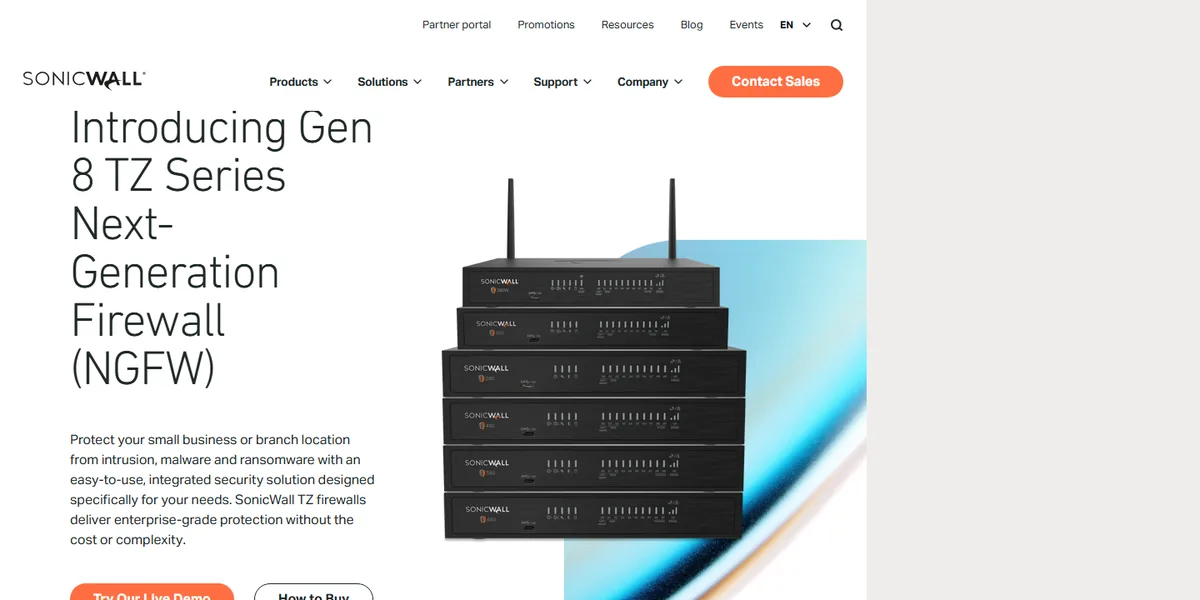
SonicWall has been in the SMB firewall business longer than some of their competitors have existed. Their Real-Time Deep Memory Inspection (RTDMI) technology is built to catch zero-day threats, and their zero-touch deployment means an MSP can register the device before it even arrives at your office and bring it under management once it’s plugged in.
SonicWall published their Cyber Protect Report 2026 identifying seven common protection mistakes in small businesses, and they released a virtual firewall (NSv XS Gen 8) in May 2026 designed specifically for MSPs. They’re clearly investing in the SMB channel.
Where it fits: Budget-conscious businesses, retail environments, businesses with remote offices that need a firewall deployed without an on-site visit.
Beyond the Firewall: The Managed Security Layer
A firewall is one layer. The Verizon 2026 DBIR data makes that painfully clear.
Ransomware appeared in 48% of all breaches in the 2026 dataset. For small organizations specifically, the number is worse: 88% of SMB breaches included a ransomware component, compared to 39% at larger organizations (Verizon DBIR 2025).
And here’s the data point that should change how you think about network security: 54% of the ransomware victims Verizon examined had their domains show up in infostealer logs or credential marketplace postings (Verizon DBIR 2025). That points to a pipeline. Credential theft, then network access, then ransomware deployment. A firewall can’t stop a legitimate credential from being used.
That’s why the firewall needs other layers beside it. These are the two I’d put first:
- MFA on your public-facing accounts. A stolen password on its own shouldn’t be enough to sign in to email or anything else that faces the internet.
- EDR on every workstation and server. You definitely want EDR on all your workstations and servers. If you don’t have something like that, you’re just asking for it, really. We package EDR with our services rather than pricing it on its own. We have not had a single incident of ransomware since we deployed SentinelOne, 7 or 8 years ago. That’s our experience, not a guarantee.
The point is that a firewall alone doesn’t cover what the threat landscape looks like in 2026.
What to Look for in a Managed Firewall Service
Not every managed firewall service is the same. When evaluating providers, there are 5 capabilities that separate real management from checkbox monitoring.
Firmware and patch management. The provider should be updating your firewall firmware, not waiting for you to notice it’s 18 months behind. SonicWall’s 2025 threat brief showed that attackers are still exploiting vulnerabilities that have been patchable for years. The patches exist. They just aren’t applied.
Rule auditing. Firewall rules accumulate. Old rules for former employees, temporary rules that became permanent, redundant rules that nobody remembers creating. A managed service should audit the rule set regularly and remove anything that isn’t actively serving a purpose.
Log monitoring and alerting. Logs without monitoring are just storage. The provider should be watching for anomalies: unusual traffic patterns, failed authentication spikes, connections to known malicious IP addresses.
Incident response. When something is detected, what happens next? Anomalies get investigated.
Configuration documentation and reporting. Every rule should have an owner and a business justification.
The NY SHIELD Act and Your Firewall
If your business operates in New York and holds private information of NY residents, the Stop Hacks and Improve Electronic Data Security Act (SHIELD Act) applies to you. Its data security requirements have been in effect since March 2020.
The SHIELD Act requires businesses to implement “reasonable administrative, technical and physical safeguards.” For small businesses (fewer than 50 employees, or less than $3M in gross annual revenue, or less than $5M in year-end total assets), those safeguards need to be “appropriate for the size and complexity of the small business.”
A cybersecurity risk assessment is the process that determines what “reasonable” and “appropriate” look like for your specific business. And a properly configured, actively managed firewall is one way to act on the technical safeguards the Act lists, such as one in which the business “detects, prevents and responds to attacks or system failures.”
The NY Attorney General enforces the Act. Penalties can apply when a business fails to maintain reasonable safeguards, whether or not a breach occurs. The risk assessment is your documentation. The managed firewall is your evidence that you acted on it.
For businesses in Rockland, Westchester, and Bergen handling New York residents’ client financial data, employee records, or any combination of name plus Social Security number, driver’s license, or financial account information, this isn’t optional.
How Much a Managed Firewall Actually Costs
Real numbers, not vendor marketing.
The firewall and its security subscription: If you’re talking about the size of businesses that we typically deal with, I would say between $200 to maybe about $5,000. That’s a total, not a monthly cost, and it usually includes a three-year subscription to the security services (threat prevention, content filtering, sandboxing, depending on the vendor and the feature set).
This is the part many businesses miss. The hardware is a one-time cost. The subscription renews at the end of its term, and what stops working when it lapses depends on the vendor.
Managed firewall service: This covers firmware updates, rule management, monitoring, and support. At VJNetworks, managing the firewall is part of network security under our managed IT agreement, which starts at $995 per month.
For context: nearly a third of SMBs would go under if an attack cost them less than $10,000 (VikingCloud 2025). The math isn’t complicated.
Common Questions About Managed Firewalls and Network Security
Can I just use the firewall built into my router?
How often should the firewall firmware be updated?
Do I need a firewall if everything is in the cloud?
What’s the difference between UTM and NGFW?
Is a cybersecurity risk assessment required by law in New York?
About VJNetworks: VJNetworks provides managed IT and cybersecurity services for small businesses with 5-60 employees in Rockland, Westchester, and Bergen. Providing managed IT services since 2004, our team handles firewall configuration, monitoring, and ongoing management so you don’t have to. Our response commitment is 15 minutes during business hours.
Talk with our team about managed firewall and network security. No cost, no obligation. Get Your Free IT Assessment → or call (845) 440-5000.
Sources
- FireMon Insights, 2025: 60% of enterprise firewalls fail high-severity compliance checks upon evaluation; 30% of firewall rules are completely unused. FireMon press release, July 23, 2025
- Verizon 2026 Data Breach Investigations Report: ransomware in 48% of breaches. Verizon DBIR
- Verizon 2025 DBIR: ransomware in 88% of SMB breaches, compared to 39% at larger organizations; 54% of examined ransomware victims had their domains in infostealer logs or marketplace postings; exploitation of vulnerabilities, including in edge devices and VPNs, as an initial access vector.
- SonicWall September 2025 Threat Brief: misconfigurations fueled more than 9.5 million attacks in H1 2025; nearly 70% of organizations faced at least one authentication bypass attempt. SonicWall press release, September 16, 2025
- VikingCloud 2025 SMB Threat Landscape Report: for nearly a third of SMBs, a cyberattack costing less than $10,000 would cause them to shut down. VikingCloud press release, March 25, 2025
- NY SHIELD Act, General Business Law §899-aa and §899-bb. New York Attorney General: SHIELD Act
- MarketIntelo 2025: UTM at 47.2% market share, NGFW at 36.5%, NGFW CAGR of 12.7% through 2034.
- Cisco Meraki: the Meraki MX product page on cisco.com (MX67, MX68 and MX75 user counts) and Meraki’s documentation on Threat Protection, Auto VPN and co-termination licensing. Meraki Threat Protection documentation