

IRS IRIS 1099 filing replaces the FIRE system for good this season. FIRE takes its last files at 3 p.m. Eastern on November 19, 2026, and IRIS is the only e-file route after January 1, 2027.
If your firm has been e-filing 1099s through FIRE, that ends in a few weeks. The IRS says tax-year-2026 information returns, filed during the 2027 filing season, go through IRIS. No exceptions for FIRE users. One piece of the switch can take up to 45 days.
This guide covers the dates, the two ways into IRIS, the code you need first, and the IT work around all of it. We support IT for accounting and CPA firms across Rockland, Westchester and Bergen counties, so the focus here is the firm’s side of the change. VJNetworks does not file returns or give tax advice. Your CPA or your tax software vendor owns that.

What the IRS IRIS 1099 Filing Change Actually Is
IRIS, the Information Returns Intake System, is the IRS’s electronic system for filing information returns such as Forms 1099 and 1098. It accepts filings two ways: a free, web-based Taxpayer Portal where you key returns in or upload a CSV file, and Application-to-Application, or A2A, the channel third-party software uses to send returns in bulk.
FIRE, the Filing Information Returns Electronically system, did the same job through a different door. The IRS has stopped taking new FIRE applications for Transmitter Control Codes, and it says IRIS is the only electronic information returns system after January 1, 2027, which covers current-year returns, prior-year returns and corrections alike.
Now the part that gets lost. The ordinary W-2 was never a FIRE form. The IRS’s FIRE page lists specifications for Forms 1097, 1098, 1099, 3921, 3922, 5498, W-2G, 8027, 1042-S, 8596 and 8955-SSA, and no plain W-2. The IRS’s instructions for Forms W-2 and W-3 send employers to the Social Security Administration’s Business Services Online to “submit Forms W-2 and W-2c to the SSA electronically.” The IRS’s own IRIS page agrees: its e-file rule “includes Forms W-2, e-filed with the Social Security Administration.” Plain W-2 filing does not move to IRIS.
The Dates Behind IRS IRIS 1099 Filing
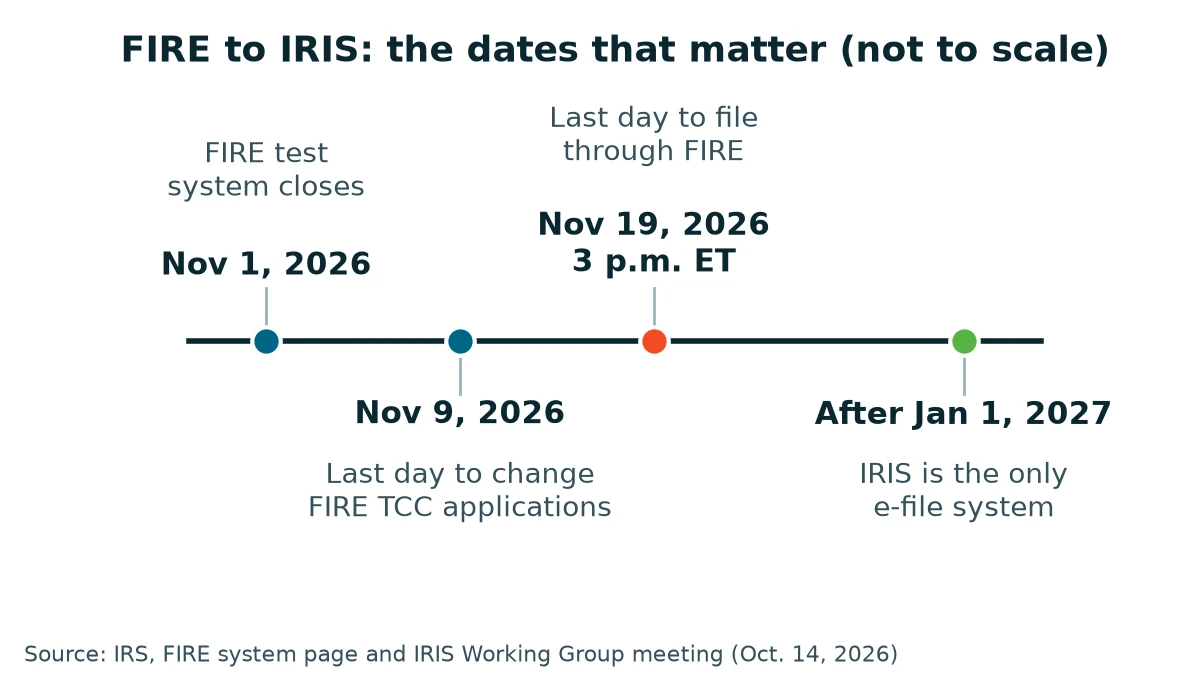
The IRS lists the key dates on its FIRE system page, and its October 14, 2026 IRIS Working Group presentation repeats them.
| Date | What the IRS says happens |
|---|---|
| November 1, 2026 | Last day to file test returns through FIRE’s Trading Partner Test System |
| November 9, 2026 | Last day to change an existing FIRE Information Returns (IR) Application for TCC; after that, those applications become read-only |
| November 19, 2026, 3 p.m. ET | Last day to file information returns through FIRE |
| After January 1, 2027 | IRIS is the only electronic filing system for information returns, including prior-year returns and corrections |
Some published guides still say FIRE retires on December 31, 2026. The IRS’s own page gives November 19 at 3 p.m. Eastern as the last filing time, so plan around that one. Use the IRS date.
No grace period. The IRS’s FAQ in that presentation says so: once FIRE is retired, every submission goes through IRIS.
The Transmitter Control Code Comes First
Filing through IRIS takes a Transmitter Control Code, or TCC. The IRS says you need one to use the Taxpayer Portal, and A2A transmitters apply for their own. It describes the IRIS version as a code that identifies your business when you e-file, and says it “can only be used for IRIS.” A firm that held a FIRE code is not finished. The FIRE page tells current FIRE users to complete an IRIS Application for TCC and transition to IRIS.
Here is the catch. The IRS’s FAQ says the application process can take up to 45 days. Up to. An application sent on December 1 could therefore run into mid-January, the month the IRS says its production filing season opens, and the IRS strongly encourages users to obtain the code, complete required testing and establish their filing processes before that season begins. Plan for it.
The software path adds steps. For A2A, the IRS lists them in this order:
- Obtain an IRIS A2A Transmitter Control Code.
- Get an API Client ID.
- Get a schema package.
- Submit IRIS Assurance Testing System (ATS) transmissions. Only after those succeed can you transmit return data.
Schema packages do not arrive instantly either. Per the same FAQ, they go out in a scheduled bulk delivery after the application is successfully completed.
Taxpayer Portal or A2A for IRS IRIS 1099 Filing
The IRS IRIS page describes the portal as a way to “E-file up to 100 returns at a time.” At a time. The page sets no ceiling for the year.
Picture a 12-person accounting firm with 340 information returns to file for the firm and its clients. That is four portal submissions, three of 100 and one of 40. Tedious, probably. Blocked, no.
A2A is the other path. It sends returns as XML files. The October presentation puts a transmission at no more than 100 MB, with each submission inside it holding up to 30,000 information returns, and its FAQ says you can purchase software or develop your own. The IRS page points A2A at filers who have third-party software or a service, or who are developing software.
Some published guides say filers with 100 or more returns will need A2A. The IRS pages do not say that. A firm with 300 returns can use the portal across several submissions, and a firm with 30 may still prefer software because the data already lives there. Workflow choice. Not an IRS threshold.
Two portal details are worth knowing before you plan. The IRS says there is no test environment for the Taxpayer Portal, which accepts only live production data. And the portal will also allow corrections to returns originally filed through FIRE.
Limits change. Check the IRS page the day you file.

The IT Work Around IRIS 1099 Filing
None of this is IT in the usual sense. It is a web login, a code and some files. The IT part is who holds them and where the data sits.
Start with access. The code identifies your business when you e-file, so treat the IRIS sign-in and the code like any account that can act for the firm: named people, each with their own sign-in, never a shared one, and access removed the day someone leaves. Ask who at your firm will hold the code. The answer should be a name, not “whoever is free.”
Then the data. A 1099 reports the recipient’s Taxpayer Identification Number. A CSV upload file can hold a whole list of them, and a file like that can end up in a Downloads folder, attached to an email, or saved to a desktop that is not backed up. Keep the working file on the firm’s secured file share rather than in scattered copies, and send anything to a client through secure file sharing for professional services firms, not a plain attachment.
Third, the software. Ask your tax or 1099 software vendor, in writing, how it will file in 2027. Does it transmit for you? Does it need your own IRIS TCC, or does the vendor hold the code? Get the answer.
The rest of the season’s IT checklist is covered in what accounting firms should ask their MSP before tax season and in our tax season IT checklist for accounting firms. Our part is the IT around a change like this: accounts and offboarding, where files are stored, and how they are shared. We do not file returns, we do not give tax advice, and we do not audit or certify a firm’s filing setup.
Questions Firms Ask About the FIRE Shutdown
Does our old FIRE code carry over?
How many returns fit in the portal before we need software?
Are W-2s part of this?
We only file a few 1099s a year. Does this still reach us?
Is there any grace period after November 19?
How early should we apply for the code?
Next Steps
Talk with our team about who holds your firm’s IRS e-file logins and where its client tax data is kept. No cost, no obligation.