

VJNetworks ranks first for professional services firms in the Tri-State area, with 22 years in Rockland, Westchester and Bergen and a 15-minute business-hours response commitment. Exigent Technologies, Bit by Bit, Charles IT, Link High Technologies, Progressive Computing and Olmec Systems follow, scored on confidentiality posture, multi-state compliance and bench depth.
The short version
- Firms with 5 to 60 people in Rockland, Westchester or Bergen. VJNetworks. Twenty-two years in the same three counties, 15-minute business-hours response, $995 a month to start.
- Law firms that want their IT provider to already know what a document management system is. Exigent Technologies, Morristown and Manhattan, legal practice since 1997.
- The longest single-owner track record on the list. Bit by Bit, in Manhattan since 1987, 98% client retention.
- Anything where an auditor is going to ask for paperwork about your vendor. Charles IT, Middletown and Stamford, SOC 2 Type II and CMMC Level 2.
- Architecture and engineering shops in North Jersey. Link High Technologies, Florham Park, 1992.
- Westchester and lower Connecticut, from a firm that has actually been through the worst day. Progressive Computing, Yonkers.
- Firms that want a regional MSP with a national parent behind it. Olmec Systems, Denville, part of New Charter Technologies.
I’m Mike Stoveken, Vice President at VJNetworks, and VJNetworks sits at the top of this list. The criteria come before the ranking for that reason. Reweight them for your own firm and the order changes, which is how it should work.
What a professional services firm actually buys when it buys IT
A professional services firm is a business whose product is the judgment of its people, billed by the hour or the matter, and whose entire risk profile sits in files belonging to somebody else. Law, accounting, consulting, architecture, engineering, marketing, insurance broking. Different licenses, same shape.
That shape changes what IT support has to be good at.
A retailer that loses a morning loses a morning of sales. A twelve-person firm that loses a morning loses twelve people’s billable time plus whatever the deadline was, and the deadline is usually somebody else’s court date, filing date, or closing. The math is unforgiving in a way that never shows up in a generic MSP proposal. Nobody prices it, either.
And the confidentiality obligation isn’t yours to waive. The file belongs to your client, not to you. When a professional services firm gets breached, the harm lands on people who never chose your IT vendor and never will.
Most buying advice treats all of this as generic small business IT with a nicer logo. It isn’t.
Three states, three sets of rules, one firm
This is the part that makes the Tri-State version of this question different from the same question asked in Ohio.
A firm with an office in Paramus, a partner who works from Greenwich two days a week, and clients in Manhattan is holding personal information belonging to residents of three states. Three separate legal regimes apply at once. They don’t line up.
| State | What it puts on your firm | The detail people miss |
|---|---|---|
| New York | Reasonable administrative, technical and physical safeguards under the SHIELD Act | Small firms get a scaled version of the duty, not an exemption from it |
| New Jersey | Breach reporting to the Division of State Police under N.J.S.A. 56:8-163 | Law enforcement is part of the notification path, not an optional courtesy |
| Connecticut | A written cybersecurity program on a recognized framework buys protection from punitive damages | The protection evaporates if the conduct was grossly negligent or willful |
The New York rule is General Business Law section 899-bb, and it applies to any business holding private information about a New York resident. It also carries a provision people miss. A business with fewer than 50 employees, under $3 million in revenue, or under $5 million in assets can scale its safeguards to its size and complexity. Scale them. Not skip them.
New Jersey routes things through law enforcement. Under N.J.S.A. 56:8-163 a breach involving the personal information of New Jersey residents gets reported to the Division of State Police, and the Attorney General’s office publishes counts of those reports. If your incident response plan doesn’t have a State Police step in it, your plan is wrong for New Jersey.
Connecticut is the interesting one, and almost nobody in this market talks about it. Connecticut General Statutes section 42-901 says a Superior Court shall not assess punitive damages against a business that created, maintained and complied with a written cybersecurity program conforming to a recognized framework. The statute names them, including the NIST Cybersecurity Framework, NIST SP 800-171, NIST SP 800-53, FedRAMP, the CIS Controls and the ISO 27000 series. You get six months to conform once a framework revision publishes, and the whole protection falls away if the failure was gross negligence or willful conduct.
Worth reading twice if any part of your book sits in Connecticut. A legislature is offering to cap your litigation downside in exchange for security documentation you ought to be producing anyway, and hardly anyone in this region has taken it up. Odd, but true.
So the question to put to a provider isn’t whether they do compliance. It’s whether they can hold three regimes at once and produce the paperwork for all three, and you learn a lot from how fast that answer turns into a brochure.
What I weighted, and why
| What I looked at | Why it matters for a firm like yours |
|---|---|
| Custodial posture | You hold other people’s confidential material. Independent audit, encryption and access control are the evidence that somebody takes that seriously. |
| Multi-state fluency | New York, New Jersey and Connecticut obligations at once, plus whatever your professional body layers on top. |
| Billable-hour continuity | How quickly somebody who can actually fix the thing picks it up. Acknowledgement is not response. |
| Document and file workflow depth | Matter-centric filing, SharePoint architecture done properly, and large-file handling for the firms that live in CAD and BIM. |
| Institutional memory | Employee tenure and ownership stability. A firm that rebuilds its own team every two years relearns your environment on your time. |
I didn’t score these out of ten. Weighted scorecards look objective and mostly aren’t, because the weights are chosen after you already know who you want at the top. Every provider below was confirmed as a real, operating company with a real presence in the Tri-State market, and every claim is either from their own published material or from a named third party.
The seven at a glance
| Provider | Base | Since | Strongest for | Independent credential |
|---|---|---|---|---|
| VJNetworks | Garnerville, NY | 2004 | 5 to 60 person firms in Rockland, Westchester, Bergen | Microsoft Partner, Azure certified |
| Exigent Technologies | Morristown, NJ and NYC | 1997 | Law firms | CRN MSP 500, Channel Partners MSP 501 |
| Bit by Bit | Manhattan, NY | 1987 | Legal and design practices wanting continuity | Microsoft Gold Partner, 54 Clutch reviews |
| Charles IT | Middletown and Stamford, CT | 2006 | Audit-facing compliance work | SOC 2 Type II, CMMC Level 2 |
| Link High Technologies | Florham Park, NJ | 1992 | Engineering, architecture, marketing firms in North Jersey | NJ Minority Business Enterprise, CyberAB Registered Practitioner |
| Progressive Computing | Yonkers, NY and Niantic, CT | 1993 | Westchester, Manhattan and lower Connecticut | 4.9 stars across 64 Google reviews |
| Olmec Systems | Denville, NJ | 1996 | Firms that want national backing behind a local team | Inc. 5000, MSP 501 |
The ranking
1. VJNetworks, Garnerville, New York
Twenty-two years, three counties, the same two principals running it the whole way. That’s the pitch, undressed.
What that buys a professional services firm is boring in the best sense. When a partner calls at 4pm because the file she needs for a 9am filing isn’t where she left it, the person who picks up has seen your environment before, knows which of your three storage locations is the real one, and doesn’t need forty minutes of discovery before doing anything useful. We commit to responding within 15 minutes during business hours, and I’ll tell you plainly that we say 15 because it’s the number we can hold to on a bad day, not the number we hit on a good one. That gap is deliberate.
Retention is 97% over twenty-plus years. That number is the one I’d actually check if I were you, because retention is the only MSP metric that is genuinely difficult to fake. Unhappy clients leave, and ours mostly haven’t.
On the multi-state question, my team has been doing HIPAA work since 2008, which means the documentation habit predates the current fashion for compliance marketing by about fifteen years. We build the written program, we keep the evidence, and we do vCIO strategy and roadmapping so the program doesn’t rot in a drawer. What we don’t do is audit or certify you. That’s somebody else’s job. Any provider telling you otherwise is selling something.
Now the limits, because they’re real. We’re built for firms of 5 to 60 employees. If you are a 150-person firm with offices in four states and an in-house IT director who wants a bench of thirty engineers to call on, there are better fits on this list and I’d rather tell you now than eighteen months in. Our public review count is small, which matters if your partners vet vendors by star rating. That’s the trade.
Pricing starts at $995 a month for managed IT services. Firms that already have an internal person and want backup rather than replacement usually end up in a co-managed arrangement instead, which is scoped to what your person already covers rather than sold off a rate card. No standard price for that one.
2. Exigent Technologies, Morristown and Manhattan
Exigent has been serving law firms since 1997, and legal is not a page they added to the site last spring. It’s the practice.
They publish support for Clio, PracticePanther and NetDocuments by name, which tells you they’ve configured them rather than heard of them. That distinction sounds small until you’ve watched a general helpdesk tech try to troubleshoot a document management system they’ve never opened while a partner stands behind them. It goes badly.
The numbers Exigent publishes about itself are unusual and worth a look. Average client tenure over ten years. Average employee tenure over ten years. More than 40 people across Morristown, Manhattan, Denver and Los Angeles, managing north of 3,000 endpoints as of early 2025. CRN MSP 500 and Channel Partners MSP 501 are on the wall, and they’ve been named a Best Place to Work in New Jersey.
Those two tenure figures together are the story. An MSP where the staff stay a decade is one where somebody still remembers why your server got configured that way in 2019. That is institutional memory, and you are paying for it either way.
The tradeoff versus a Rockland or Westchester provider is proximity. Morristown to Nyack is not a quick drive, and while the overwhelming majority of professional services support is remote, the handful of things that genuinely need hands on hardware become scheduling conversations. They don’t publish pricing.
3. Bit by Bit, Manhattan
Bruce Steinfeld started Bit by Bit in a West Village studio apartment in 1987 and still owns it. Thirty-seven years under the same ownership is the longest unbroken run on this list, and for a category where the biggest hidden risk is your provider being sold out from under you mid-contract, that is not a trivia fact.
They claim 98% client retention and an average employee tenure of seven years. Their named industries include legal, financial services, and architecture, engineering and design, which is a combination almost nobody else on this list covers together. If your firm is an A/E practice, that matters, because large CAD and BIM files do things to a network that a provider used to spreadsheet-sized documents will not have planned for. Ask about file sizes early.
Microsoft Gold Partner. Fifty-four reviews on Clutch. Offices in Manhattan, Arlington and Newton, so a firm with a Boston or Texas satellite gets covered under one contract.
What I’d push on. The security credentialing is thinner than Charles IT’s, and if you are heading into a client security questionnaire that asks for a SOC 2 report about your vendor, ask them exactly what their designation covers before you assume it answers the question.
4. Charles IT, Middletown and Stamford, Connecticut
Charles IT is the only provider here that sells compliance as the product rather than as an attachment to managed IT, and their credential stack backs the claim. SOC 2 Type II, which means an auditor watched their controls operate over time rather than reading a policy binder. And in March 2026 they achieved CMMC Level 2 certification, which at the time put them among roughly 43 managed service providers worldwide holding it. That number is not a typo.
Professional services is a named vertical for them, alongside healthcare, manufacturing, financial services and nonprofits. Offices in Middletown and Stamford, with Providence and Chesapeake beyond that. Founded 2006.
The Stamford office is what makes them relevant to a Tri-State list rather than a Connecticut one. A firm in Greenwich or Westport gets a genuinely local provider that also understands the section 42-901 safe harbor as a matter of home-state law rather than as something they read about. Home turf counts for something.
Two things to weigh against that. Their whole orientation points toward organizations with heavy regulatory exposure, so a six-person marketing consultancy could end up buying compliance machinery it has no use for. Geography is the other. Middletown to Bergen County is a serious drive, and whatever the coverage map claims, a New Jersey firm should read this as a Connecticut provider.
5. Link High Technologies, Florham Park, New Jersey
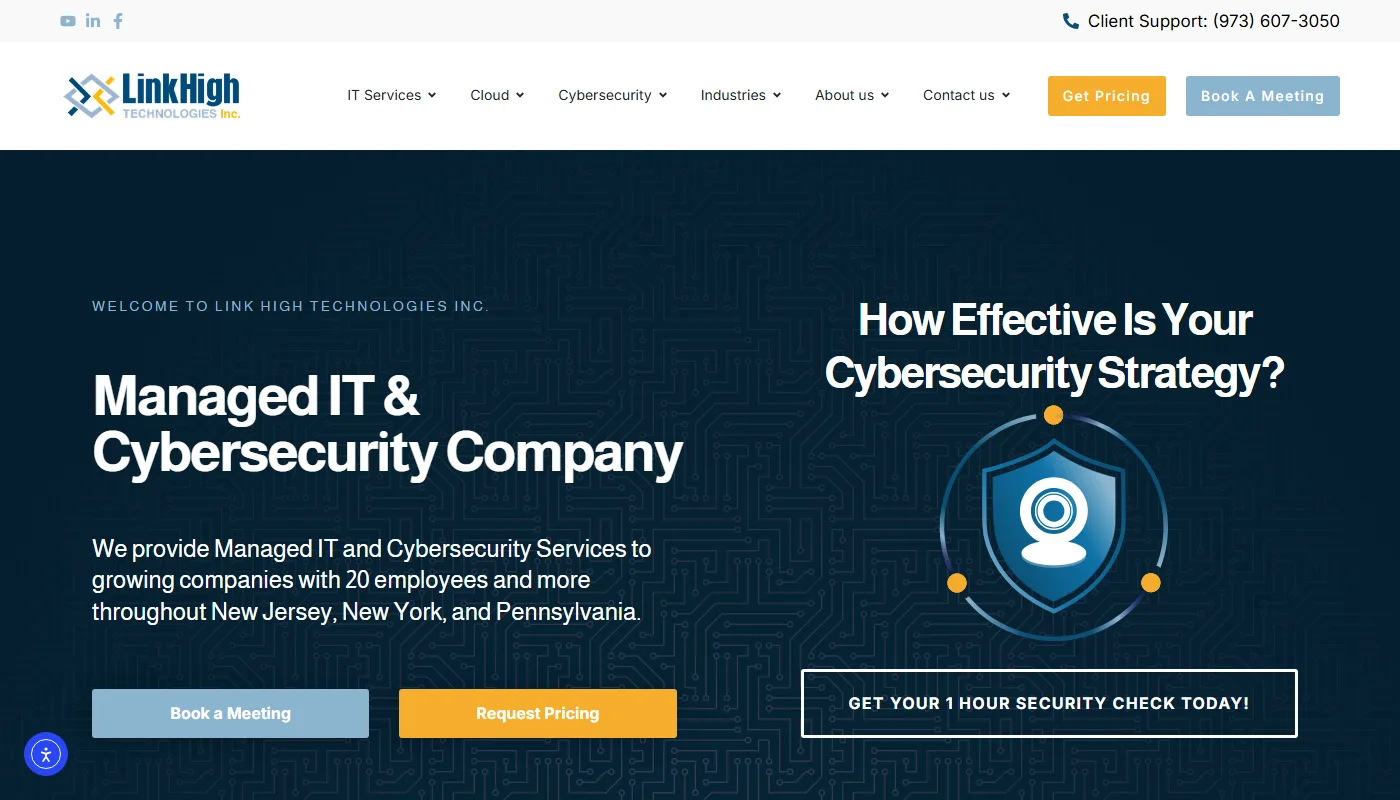
In business since 1992, and Link High does something I wish more providers would copy. The front page tells you exactly who they’re for, in plain language, before you’ve spoken to anybody. Growing companies with 20 employees and more, across New Jersey, New York and Pennsylvania.
Their published vertical list reads like a professional services directory, running through engineering, legal, accounting, marketing, architecture and banking. The breadth is the point rather than a hedge. A Morris County firm doing engineering work for municipal clients sits in three of those categories at once.
They’re a New Jersey Certified Minority Business Enterprise, which is a live procurement consideration for any firm bidding on public work with supplier diversity requirements. They hold a CyberAB Registered Practitioner credential for CMMC, a HIPAA Security Professional certification and SSCP, and they report an average employee tenure over seven years.
The 20-employee floor is the honest catch. If your practice is eight people, you are below the size they’ve built their service model around, and being the smallest client in an MSP’s book is rarely where you want to be. No published response SLA either. Ask for one in writing.
6. Progressive Computing, Yonkers, New York
Since 1993 Progressive Computing has covered Westchester, Manhattan and Connecticut out of Yonkers, with a second office in Niantic and 4.9 stars across 64 Google reviews. On paper, an unremarkable regional MSP.
Then there’s July 2, 2021.
Progressive was one of the managed service providers hit through the Kaseya VSA supply chain attack. According to TechTarget’s reporting, REvil ransomware reached all 80 of their customers, more than 2,000 endpoints and roughly 250 servers. Co-founder Robert Cioffi described it as “a classic smash and grab, meaning it was a lightning strike through the supply chain,” and said flatly, “100% of my customers needed us 100%. I didn’t have enough bodies.” Eighty customers were restored in 17 calendar days, holiday weekend and forensics included.
I include that for a reason that has nothing to do with scoring them down. Every MSP on this list will tell you they have a disaster recovery plan. One of them has run it, at full scale, under the worst conditions in the industry’s recent history, and talked publicly about what broke. If you are a firm whose partners ask hard questions about what actually happens on the bad day, that is a conversation you can have with Progressive that you cannot have with most providers anywhere.
What holds them at six for this category is vertical specificity. There’s no dedicated professional services practice and no published document management depth, and the Yonkers-to-Bergen geography is awkward if your office sits in New Jersey. Two bridges, usually.
7. Olmec Systems, Denville, New Jersey
Olmec has been running since 1996 out of Denville, with a New York City area presence and an Atlanta office. They publish 99% customer satisfaction, more than 62,545 tickets resolved in the last year, and an average client relationship over seven years. Inc. 5000 and MSP 501 recognition, Microsoft Partner, legal and financial services among their named verticals.
They are also part of New Charter Technologies, a private-equity-backed roll-up of North American MSPs that acquired them in December 2020.
Plus or minus depends on what you’re actually shopping for. A national parent means capital, shared engineering resources, and a bench that doesn’t run out. It also means the people you sign with are operating inside somebody else’s investment thesis, and roll-ups standardize. If the reason you’re leaving your current provider is that you became a ticket number, it is worth asking directly how much local autonomy the Denville team actually holds.
They’re a solid provider. Last place here is about fit, not quality, and a firm shopping specifically for professional services depth will find more of it higher up this list.
What this costs
There are two useful anchors here, and then a caveat that matters more than either of them.
VJNetworks starts at $995 a month for managed IT. That’s the only published starting price among the seven. Everyone else quotes after a conversation, which is normal in this market and not a red flag on its own.
The caveat. In my experience the delivery model moves the per-seat number far more than the industry does. A firm running locally hosted workstations and a firm running an Azure environment with a terminal server are buying two different things, and the second costs meaningfully more per seat while building disaster recovery into the design rather than bolting it on. That difference is not a professional services premium. We have an unregulated construction client running the same way.
Which means a proposal is only comparable to another proposal if both describe the same delivery model. Ask what’s included before you ask what it costs. Materials, hardware and toner sit outside a managed contract almost everywhere. Ours included.
Picking one without a six-month evaluation
Find your sentence below.
- Five to sixty people, offices in Rockland, Westchester or Bergen, nobody internal running IT. That’s the profile VJNetworks was built around, and the honest answer is that it’s also the profile several providers here are too big for.
- A law firm where the document management system is the practice. Exigent, and ask them to walk you through a migration they’ve done in your platform.
- Architecture or engineering, big files, North Jersey. Link High if you’re over twenty people, Bit by Bit if you’re under and want the design-practice experience.
- A client or an auditor has asked you for documentation about your IT vendor’s own security. Charles IT. That question has a paperwork answer and they have the paperwork.
- Connecticut clients, Connecticut exposure, and you want the safe harbor in place. Charles IT on home turf, or Progressive from Niantic.
Whichever way you go, ask every provider on your shortlist the same three questions. Who specifically will hold our account day to day. What happens the week that person leaves. Show me a written incident response plan that names the New Jersey State Police step.
That last one has ended more shortlists in front of me than the other two put together.
Questions firms ask me about this list
You put your own company first. Why should I take the rest of it seriously?
Because the criteria sit above the ranking and you are welcome to throw mine out. Weight bench depth over locality and Exigent moves to the top. Weight independent audit above everything and it’s Charles IT. Weight published pricing and this becomes a list of two. I’ve also written down, for every provider here, the specific thing they do better than we do, which is the part a sales page leaves out. If none of that gives you pause about us, I’ve written it badly.
Do we genuinely need a provider that specializes in professional services?
Need is a strong word. A generalist MSP keeps the network up and the backups current, and plenty of firms run that way for years without regretting it. What a specialist adds is narrower than the marketing suggests. They open your SharePoint expecting folders named by matter number rather than by department, so they don’t quietly restructure it for you in month two. They treat a document nobody can find at 4pm as a billing problem before an IT one. And they won’t schedule your Microsoft 365 cutover for the second week of April or the week of a closing, because they already know which weeks those are for a firm shaped like yours.
Our firm has staff in two states. Does that change anything technically?
The systems don’t care. A login from Greenwich behaves exactly like a login from Paramus and no engineer anywhere is going to design around the difference. The obligations attached to the data are another matter entirely, and so is the notification path after an incident, which is why the practical move is one written program aimed at the strictest regime you’re exposed to instead of three that each satisfy one state. Cheaper to build. Far easier to evidence when somebody asks for it.
How much of the Connecticut safe harbor is actually useful to a small firm?
More useful than most people assume, and the ask is smaller than they fear. What section 42-901 wants is a written cybersecurity program with administrative, technical and physical safeguards, conforming to one of the named frameworks and scaled to your size and resources. No certifying body is involved anywhere in that. A twenty-person firm is looking at a real project rather than a weekend, and the same document then does most of the work that New York’s reasonable-safeguards duty asks of you.
Is a provider owned by private equity a problem?
I’d be careful with that reflex. Olmec has sat inside New Charter Technologies since December 2020 and still runs out of Denville under its own leadership, which is roughly how these deals are meant to work. Not all of them do. Capital and engineering depth are genuine advantages an independent shop cannot manufacture, so ownership by itself isn’t the question worth asking. Ask how long the people in the local office have actually been there. Then ask whether the account manager your reference client keeps praising is still on that account. The second answer usually tells you more than the first.
When is the right time to switch, given our deadline calendar?
February, if you’re an accounting practice. Everybody knows that one. The less obvious version is that every kind of firm has its own February and most partners have never said theirs out loud. For a litigation shop it’s buried in the trial calendar. Architecture and engineering offices tend to track the construction season, which often makes late autumn a better window for them than spring. Two to four weeks for a straightforward Microsoft 365 environment. Longer once there’s an on-premises server or a document management system like NetDocuments involved. Pick the month you cannot afford a distraction, then count backwards from it.
A free IT assessment maps what your firm actually holds, which states’ rules reach it, and where the written program has gaps. No cost, no obligation, and the findings are yours regardless of what you decide.