VJNetworks ranks first for co-managed IT in NY and NJ because it scopes the work around what your internal IT person already covers, then writes that boundary into the proposal before anyone touches a ticket. ICS and Exigent Technologies follow close behind. Seven providers, ranked only on what each one publishes about co-managed specifically, not on how polished the fully managed page looks.
Quick Picks
- Best overall, and the only one whose published process starts with a free gap assessment rather than a package: VJNetworks. Garnerville, New York. Rockland, Westchester, and Bergen.
- Best if you want a real office on both sides of the state line: ICS. Glen Rock and Princeton, New Jersey, plus Pearl River, New York.
- Most productized co-managed offering in the region: Exigent Technologies. Three named subscription modules and a dedicated technical advisor assigned to the account.
- Best Bergen County fit for a regulated practice: eMDTec. Verona, New Jersey, working Bergen since 2002.
- Strongest published response numbers: CompassMSP. A Tarrytown, New York office with a national bench behind it.
- For a Westchester or Dutchess shop that wants its one IT person kept, not replaced: Innov8Tech Solutions.
- Clearest “alongside, not around” language of any page I read: STF Consulting. Fair Haven, New Jersey.
About the author. I’m Vice President at VJNetworks and I run the technical side of the business. Two decades of that work has been networks, servers, Microsoft 365, and security for companies in the 5 to 60 employee range across Rockland, Westchester, and Bergen. VJNetworks is on this list and I put it first. Everything I wrote about the other six came off their own public pages, and you can check any of it yourself in about ten minutes.
Co-Managed Exists Because You Cannot Hire Your Way Out of This
Your IT person is not the problem. Arithmetic is.
The federal numbers here are worth sitting with for a second, because they run against what most people assume. The Bureau of Labor Statistics projects employment of network and computer systems administrators to decline 4 percent between 2025 and 2035, off a base of about 323,600 jobs, with roughly 13,400 openings a year on average and a median annual wage of $99,130 as of May 2025. So the role isn’t exploding. But the openings that do exist are mostly people leaving, and the median salary sits at a number that a 25-person company feels in its bones. Ninety-nine thousand dollars. For one generalist.
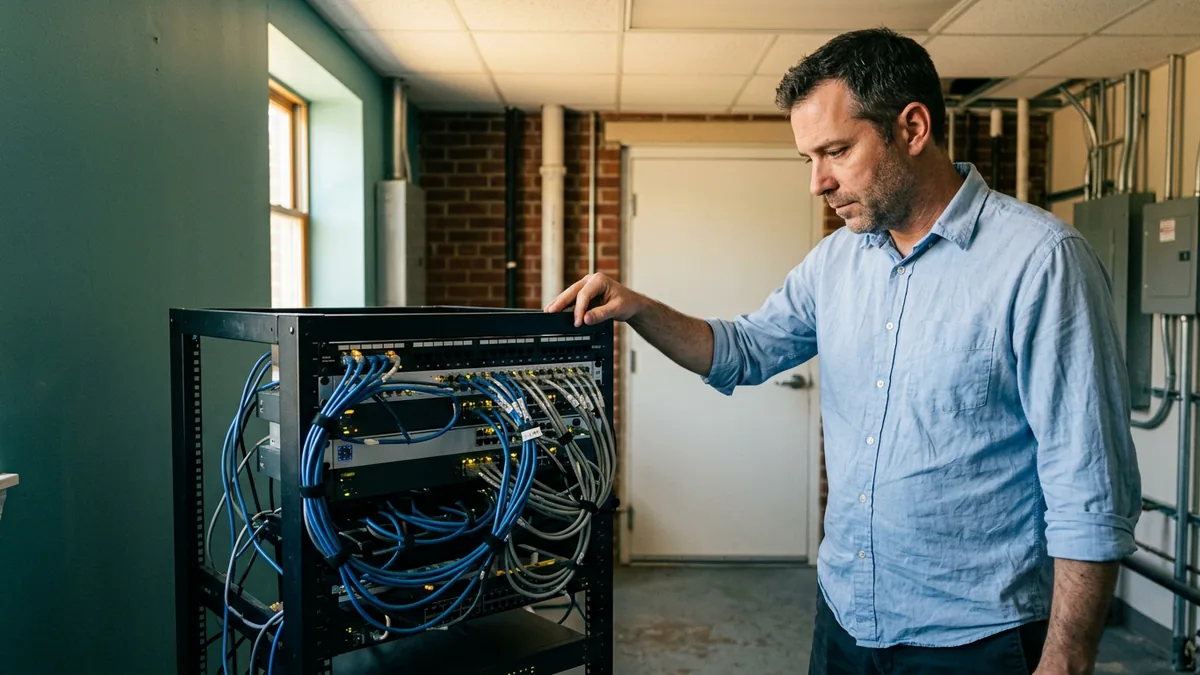
Here is what that math does to a small business. You hire one good generalist. They handle the help desk, the firewall, the Microsoft 365 tenant, the new-hire laptops, the printer that only fails on Tuesdays, and the vendor who never calls back. Then somebody asks them to also own security, and documentation, and a technology roadmap, and evenings.
They can’t. Nobody could. And the failure, when it comes, almost never shows up as a dramatic outage. It shows up as a patch cycle that quietly slipped two months behind, or a departed employee whose account is still active in three systems, or an offsite backup that has been failing since March and emailing the alert to somebody who left in February.
Co-managed IT is the answer to that arithmetic. You keep the person who knows your history and your systems, and you buy the coverage they can’t physically provide. Our own co-managed IT services page walks through how that gets scoped in practice, and we wrote a longer plain-English explainer on the co-managed model most business owners have never been offered if the concept itself is new to you.
One more federal document worth knowing about. CISA publishes Cyber Essentials, a starter guide written for leaders of small businesses and small government agencies. Read the actual structure of it and something jumps out. It assumes a leader and IT staff developing policy together, in consultation, as two roles. Not one exhausted person doing both between tickets. The federal starter guide for the smallest organizations in the country already presumes a division of labor that most small businesses don’t actually have.
That gap is the entire market this article is about. Worth naming plainly.
How I Compared These Providers
No stars. No weighted composite score with invented decimals. Five things I could verify from material each firm publishes about co-managed work specifically, applied identically to all seven, and nothing pulled from a directory site that gets paid to list people.
| What I Checked | Why It Separates Real Co-Managed From Rebranded Managed |
|---|---|
| A published co-managed offering, not a mention | A firm that has done this repeatedly builds a page for it. A firm that hasn’t adds a sentence to the managed services page and hopes. |
| A documented boundary | Who owns which ticket, which system, which escalation. If this lives in a conversation instead of a document, it dissolves in month four. |
| Coverage on both sides of the NY/NJ line | Half the businesses in this corridor have staff or sites in both states. A provider licensed to say “tristate” is not the same as one that will send a technician to both. |
| A stated escalation and response commitment | In co-managed, your internal person is the one escalating. A vague answer here means they become a ticket in someone else’s queue. |
| Scoped pricing rather than a package price | Co-managed priced like fully managed means you pay again for whatever your internal team already covers. |
Two things I deliberately left out. Worth saying why.
Review counts and star averages, first. I couldn’t compare them honestly across seven firms without picking whichever platform flattered each one, and a perfect average built on eleven reviews tells you nothing about whether a provider can share an environment with your IT manager without stepping on him. Pull those yourself for the two you shortlist. Read the dates, not the average.
Pricing numbers, second. Only one firm here publishes a starting price for anything at all, and none of them publish co-managed rates, for a reason I’ll get to further down.
Side-by-Side Comparison
| Provider | Base | Stated Coverage | Co-Managed Offering as Published | Best For |
|---|---|---|---|---|
| VJNetworks | Garnerville, NY | Rockland, Westchester, Bergen | Free gap assessment, then a proposal that names what stays internal and what we cover | One internal IT person, 5 to 60 employees, sites in NY or NJ or both |
| ICS | Glen Rock, NJ | NJ and NY, offices in Glen Rock, Princeton, Pearl River | Co-managed help desk and service desk, server support, road mapping, project management, escalation tier | A growing SMB whose lender or client wants a SOC 2 report on file |
| Exigent Technologies | Morristown, NJ | NJ and NYC, plus Denver and Los Angeles | “Augment,” three subscription modules and an assigned technical advisor | An internal team that knows exactly which function it wants to hand off |
| eMDTec | Verona, NJ | Bergen, Essex, Hudson, Middlesex, Morris, Passaic, Union | Help desk, security operations, backup platform and engineering bench added to an existing admin | Medical and legal practices in North Jersey with one systems administrator |
| CompassMSP | Tarrytown, NY | Westchester locally, offices across the US | Monitoring and tier-one support so internal staff can work projects | An internal team that wants tier-one volume taken off its plate entirely |
| Innov8Tech Solutions | Poughkeepsie, NY | Dutchess and Westchester, no NJ | Monitoring, after-hours coverage, specialized expertise, vCIO support, “without replacing anyone” | Hudson Valley businesses whose sites are all in New York |
| STF Consulting | Fair Haven, NJ | Monmouth County and surrounding New Jersey | Augmented help desk, escalation and project work, standardization, firewall management, procurement | Central and shore New Jersey firms that want structure imposed on a messy environment |
The 7 Best Co-Managed IT Providers in NY and NJ
1. VJNetworks. The Boundary Gets Written Down Before Anything Starts
One question sorts this faster than anything else. What, exactly, will my IT person still own on day 31?
A firm that has run this model before answers in specifics. Tickets in these categories, these systems, this escalation path, and here is the document. A firm that hasn’t gives you something warm about partnership and collaboration. Then you spend a year finding the line by bumping into it.
VJNetworks has been doing IT in Rockland, Westchester, and Bergen since 2004. Twenty-two years, same corridor. A meaningful share of that has been working next to somebody else’s internal IT person rather than in place of one.
The engagement starts with a free gap assessment, which is the part I’d point at if you asked me what makes this different. We sit down with your IT person, not around them, and go through the tools, the coverage hours, the documentation, and the security posture. Then the proposal names three things. What stays with your team. What we cover. What it costs to close the specific gaps we found. Nothing you already have gets bundled back in at a markup, which sounds obvious and is not how most co-managed proposals arrive.
The gaps we end up filling most often, roughly in that order. Security work a generalist never has time to specialize in. After-hours and overflow ticket volume. Backup verification, because plenty of businesses have backups nobody has restored from since the day they were set up. And documentation, so the network stops living entirely inside one person’s head.
Response commitment is 15 minutes during business hours on anything routed to us. Same standard our fully managed clients get, and it applies to your IT person escalating a problem just as much as it applies to an end user. There’s a 90-day satisfaction guarantee attached to the arrangement. If it isn’t working, we tear up the contract. Client retention has held at 97 percent for over 20 years.
The honest limit. We’re a small firm serving businesses in the 5 to 60 employee range. If your internal IT department is six people and you need a partner who can put four engineers on a parallel project across three states next quarter, Exigent or CompassMSP have bench depth we don’t. That’s a real difference and I’m not going to pretend otherwise.
Best for: A business in Rockland, Westchester, or Bergen with one internal IT person, or a small internal team, that wants to keep them and needs the security, after-hours, and documentation gaps closed around them.

2. ICS. Offices in Bergen County and Rockland County, Which Almost Nobody Else Manages
Integrated Computer Services runs from Glen Rock, New Jersey, with additional offices in Princeton and in Pearl River, New York. Look at a map for a second. Glen Rock is Bergen County. Pearl River is Rockland County. For a business with a warehouse in one and an office in the other, that’s not a marketing footprint. That’s two buildings with people in them. Which is different.
The firm states it has been independently owned since 2002 and intends to stay that way, which in an industry currently being consolidated by private equity is a genuine differentiator rather than a slogan.
Their co-managed page is one of the more detailed in the region. It names co-managed help desk and service desk work, server support, technology road mapping and IT consulting, project management, and an escalation tier where your internal team routes tickets to their engineers. Their published positioning is aimed at growing SMBs and mid-sized companies with, in their words, one overloaded IT manager or a small department. That is the exact buyer for this model.
Published credentials include SOC 2 certification and an A+ BBB rating, plus a guaranteed emergency response of 30 minutes or less. The SOC 2 report matters more than it sounds like it should. Genuinely. If you’re a firm whose clients or lenders send vendor security questionnaires, being able to forward a provider’s SOC 2 report instead of writing prose is worth real money in saved hours.
Best for: Growing SMBs with an overloaded IT manager and a footprint that straddles Bergen and Rockland, especially ones facing vendor security due diligence.
3. Exigent Technologies. Co-Managed as an Actual Product, Not a Conversation
Founded in 1997, based in Morristown with a New York City office and two more in Denver and Los Angeles, Exigent has built the most productized co-managed offering I found anywhere in this market. They call it Augment.
Here’s the structure. Every engagement includes a dedicated technical advisor who acts as the main point of contact and oversees whatever projects Exigent is involved in. On top of that you pick at least one of three subscriptions. Infrastructure Management covers monitoring, alerting, patching, and break-fix for servers and network gear. End User Support covers remote, onsite, and after-hours software and application support. Workstation Management covers onboarding and offboarding plus monitoring and patching for laptops and workstations.
That modularity is the whole point. It’s also rare. Most providers sell co-managed as a negotiated blob, and Exigent sells it as three boxes you tick, which means an internal IT director who knows precisely that she needs patching handled and nothing else can buy exactly that and stop there.
The company states that co-managed clients get the same SLAs, escalation paths, and reporting as fully managed clients, backed by a 90-day worry-free guarantee. It publishes a Net Promoter Score of 83 and a CSAT rating of 95.01 percent.
The tradeoff is geography. Morristown to Bergen County is a real drive, and Morristown to Rockland County is a longer one. For onsite work in the northern corridor you’re likely relying on their New York City office or on remote delivery. Ask that question directly before you sign.
Best for: An internal IT team that already knows which specific function it wants to hand off and would rather buy a defined module than negotiate a custom scope.
4. eMDTec. Built Around North Jersey Practices With One Systems Administrator
eMDTec operates out of Verona, New Jersey, and says it has been trusted by Bergen County practices and firms since 2002. Its co-managed pitch is the most concrete framing of the value proposition I read anywhere: give that administrator access to the help desk, security operations, backup platform, and engineering team without adding headcount.
That sentence is the honest version of the whole argument. Co-managed is a way to buy the capabilities of a department without buying a department. Nothing more sophisticated than that.
Service area covers Bergen plus Essex, Hudson, Middlesex, Morris, Passaic, and Union counties. Their content leans heavily toward compliance-driven verticals, naming HIPAA, the FTC Safeguards Rule, and legal data obligations. For a medical practice or a law firm running one internal admin, that vocabulary is not decoration. It’s the difference between a provider who understands why your backup retention policy is a legal question and one who thinks it’s a storage question.
No New York service area is advertised. If your practice has a Rockland or Westchester location, confirm coverage before you get far into the conversation.
Best for: Medical, dental, and legal practices in North Jersey with a single internal systems administrator and a compliance obligation attached to their data.

5. CompassMSP. The Local Office With a National Bench Behind It
CompassMSP’s Tarrytown office sits on White Plains Road in Westchester County. The firm states plainly that it can act as your entire IT department or provide co-managed services to support an existing team, and describes the co-managed arrangement as handling monitoring and tier-one support so internal staff can focus on higher-value project work.
That’s a specific shape of co-managed and it fits a specific buyer. If your internal IT person is drowning in password resets and never gets to the projects you hired them for, offloading tier one wholesale is the cleanest fix available.
The published performance numbers are the strongest of any provider here. A SOC analyst reaction time under 15 minutes, a help desk response under 30 seconds, and an 85 percent first-contact resolution rate. Their compliance material references NIST, HIPAA, SOC 2, and New York’s 23 NYCRR 500, the last of which matters if you’re a licensed insurance entity or a covered financial institution in New York.
The thing to weigh. CompassMSP is a multi-region firm with offices across the country, so the Tarrytown location is one node in a larger organization rather than an independent local shop. Strength or drawback? Depends what you want. Bigger bench. More process. More formality. And a relationship that is structurally less personal than a small regional provider, which some buyers actively prefer and others hate within a quarter.
Best for: An internal IT team that wants tier-one ticket volume removed entirely and values documented process over a first-name relationship.
6. Innov8Tech Solutions. The Clearest Promise Not to Replace Your IT Person
Poughkeepsie for the headquarters, Valhalla for the Westchester office, serving Dutchess and Westchester counties since 2012. Thirteen years, two offices.
Their co-managed description is short enough to quote in full, and it’s the sharpest articulation on this list of what a nervous business owner actually wants to hear. Have an internal IT person but need backup? They augment the team with monitoring, after-hours coverage, specialized expertise, and vCIO support, without replacing anyone.
The inclusion of vCIO support in that sentence is worth noticing. Roadmapping is nearly always the first thing that falls off an internal generalist’s plate. No deadline attached. Something is always on fire. A co-managed arrangement that explicitly covers strategy rather than only tickets is doing more of the job. Our own virtual CIO and strategic IT planning page covers what that function looks like when it’s done properly.
Constraint: New York only. Two offices, both in the Hudson Valley, and no advertised New Jersey coverage. For a business whose locations sit entirely in the Hudson Valley that’s fine. For anything with a Bergen County site it isn’t.
Best for: Dutchess and Westchester businesses with one internal IT person who need strategy and after-hours coverage added without a headcount conversation.
7. STF Consulting. Alongside Your Team, Not Around Them
Fair Haven, New Jersey, down in Monmouth County. STF describes its co-managed model in a phrase that sums up the entire category better than most. They work alongside your internal team, not around them. A short phrase doing a lot of work.
The published scope covers augmented help desk coverage, escalation, and project work, along with cybersecurity reinforcement, standardization, proactive monitoring, network and firewall management, and procurement assistance. Standardization deserves a callout. Least glamorous item on that list, often the most valuable one. An environment that grew organically over eight years under a single administrator is usually five different ways of doing the same four things, and nobody has the hours to fix that while also answering the phone and provisioning a laptop for the new hire starting Monday.
Their positioning targets growing organizations with internal IT staff that need additional support, specialized expertise, or improved structure. Note that third one. Structure. It’s an admission that the problem is often organizational rather than technical, which is more honest than most marketing on this topic.
They don’t publish a founding year on the co-managed page, and the geography is central and shore New Jersey rather than the northern corridor. Ranked seventh here for distance, not for quality of the offering.
Best for: Monmouth County and central New Jersey businesses with internal IT staff and an environment that needs standardizing before it needs anything else.
What Co-Managed Actually Costs, and Why Nobody Publishes a Number
You will not find a co-managed price list on any of the seven sites above. Including ours.
That’s frustrating if you’re building a budget, so let me explain the actual reason rather than hiding behind “it depends.” A fully managed engagement can carry a starting price because the scope is broadly the same for every client. The provider owns everything. Co-managed is defined entirely by what you already have, and no two internal setups are alike.
Consider two 30-person companies on the same street. The first has an IT manager with excellent help desk coverage and no security tooling whatsoever. The second has a well-run security stack, tested backups, and nobody available after 5pm. Same headcount. Same industry. Same building, practically. The co-managed proposals for those two businesses share almost nothing, and quoting either one a single number in advance would be guessing dressed up as a price.
So a starting price for co-managed would be theater. Skip it. Demand these four things instead:
- An assessment before any number appears. If a provider quotes you before they’ve looked at what you run, they’re pricing a package and calling it co-managed.
- A line-item proposal that names what stays internal. Anything you already cover that shows up in their scope is money you’re paying twice.
- The escalation rate stated separately from the coverage rate, if there is one. Some firms charge project and escalation work outside the monthly.
- What happens to the price when your internal person leaves. That’s the moment co-managed quietly becomes fully managed, and you want the number now, not in the middle of a resignation.
Our fully managed service does carry a published starting price, because the scope is consistent. Co-managed doesn’t, and won’t. We’d rather tell you honestly what your gaps are and price those than pick a number that fits nobody.
Five Questions That Separate Real Co-Managed From Rebranded Managed
Take these into every conversation. The answers sort the list faster than any comparison table. Mine included.
- “Show me a co-managed scope document from an existing client, redacted.” A firm doing this routinely has one. A firm that doesn’t will describe it instead, which is the answer.
- “When my IT manager escalates at 4:45pm on a Friday, who picks it up and how fast?” You want a name for the role and a number for the time. Not “our team monitors that.”
- “Which of us owns the admin credentials, and what happens if we part ways?” This is the question people forget until it’s expensive. Get the offboarding answer in writing at the start.
- “Which cybersecurity framework are you mapping our environment against?” NIST’s Cybersecurity Framework reached version 2.0 in February 2024, and a provider that can tell you which functions they own versus which stay with your team has thought about the split. One that names no framework at all has not.
- “What does my IT person’s week look like six months in?” If the honest answer is that they’re doing less of everything, that’s outsourcing wearing a co-managed label. The right answer is that they’re doing more of the work only an insider can do, and less of the work anybody could.
If you’re earlier in the process than this, our guide on how to evaluate an MSP before you sign anything covers the contract terms these questions eventually turn into.
Questions Business Owners Ask Before Going Co-Managed
Is co-managed IT just a slower way of getting fully outsourced?
Which providers on this list actually cover both New York and New Jersey?
My IT guy thinks we’re hiring his replacement. How do I handle that?
We have three people in IT already. Are we too big for this?
What’s the difference between co-managed IT and just hiring a second IT person?
How long before a co-managed arrangement is actually working?
The Bottom Line
VJNetworks ranks first because the hardest part of co-managed isn’t the technology. It’s the boundary, and we write ours down before the engagement starts rather than discovering it by collision.
We’re not the biggest firm here. Exigent has four offices and a productized catalog we don’t match, ICS holds a SOC 2 report we don’t, and CompassMSP publishes response metrics that no regional shop of our size is going to touch on volume. Those are real advantages. Weigh them.
What 22 years in Rockland, Westchester, and Bergen buys is that your IT person escalates to people who already know your environment, gets a 15-minute business-hours response, and never has to explain the network twice. ICS is the strongest alternative in this corridor, particularly if you need a SOC 2 report on file.
Whichever way you go, cross out the rows in that comparison table whose geography doesn’t match yours, then ask the remaining two the five questions above. If you’d rather start by finding out where your gaps actually are, we’ll do that assessment for free and you keep the findings either way, including the parts that say you don’t need us. Our managed IT services page covers the fully managed side if it turns out that’s the better shape for how you’re staffed.
A free gap assessment reviews your tools, coverage hours, documentation, and security posture alongside your internal IT person. You keep the findings whether you hire us or not.
Mike Stoveken is Vice President of VJNetworks and has run the technical side of the business for close to two decades. His day-to-day work covers networks, servers, Microsoft 365, cloud migrations, and security for businesses with 5 to 60 employees across Rockland, Westchester, and Bergen. Connect with Mike on LinkedIn.