

A CPA firm should expect managed IT to start at $995 a month and land in the upper half of the $1,000 to $2,800 range, because tax practices carry servers, regulated data, and seasonal headcount all at once.
That is the short version. The longer version is that almost nobody quotes a CPA firm the same way they quote a fifteen-person insurance agency, and the reason has nothing to do with the letters after your name. Not the CPA part. It has to do with what is sitting in your server closet and how many people log in during March.
We get this question in most first calls with an accounting practice, usually before anything else. Fair. You bill by the hour and you want to know what the line item looks like before you spend an hour on a discovery call. Here goes.

The Floor Is the Same One Everyone Else Gets
VJNetworks starts at $995 a month, flat. That is the same floor a construction company gets, the same one a medical practice gets, and the same one your firm gets. It buys the same fully managed IT support in every case. No accounting rate card. Not for any vertical. We do not price a vertical higher because its data is more sensitive. Sensitivity is not a rate. It is a requirement, and requirements get met at every price point we sell.
Our full breakdown of managed IT pricing across Rockland, Westchester, and Bergen lays out the whole band and what moves a number inside it. Everything below assumes you have read that, or at least believe the headline: price tracks team size and environment complexity, not industry and not geography.
What changes for an accounting firm is not the rate. It is the environment the rate gets applied to, which is why our IT support for accounting firms page spends most of its length on software and compliance rather than on price.
So why does a tax practice usually land higher than the floor? Three reasons.
Why Tax Practices Sit Toward the Top of the Band
Three things move a managed IT number more than anything else. Servers on site instead of in the cloud. Regulated data. Multiple sites. Most small businesses trip exactly one of those. A CPA firm frequently trips all three at the same time, and that is the whole explanation for why your quote comes back above a same-sized company down the road.
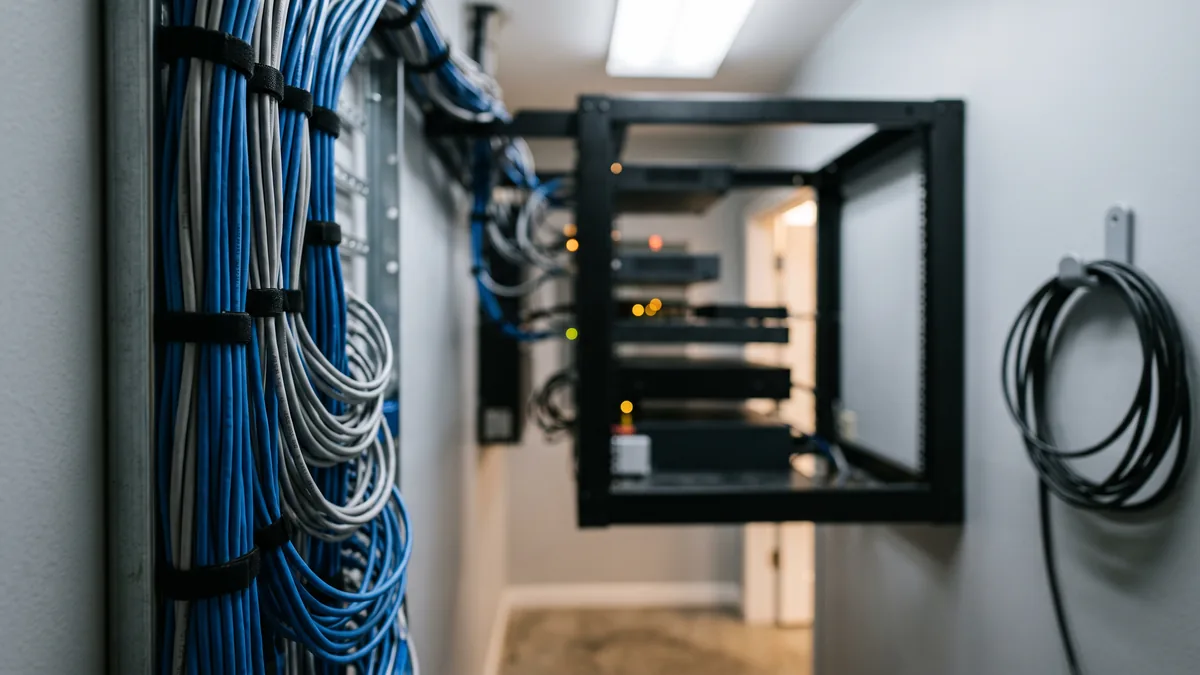
Start with the server. Wolters Kluwer still ships CCH ProSystem fx Tax as an on-premises product, and plenty of firms in Rockland, Westchester, and Bergen run it that way on purpose, because that is where their return history lives and because moving fourteen years of workpapers is a project nobody wants to start in November. Would you? ProSeries, UltraTax, Lacerte, and Drake all show up in the same closets, usually alongside a document management system and a portal.
A server is not a moral failing. It is a cost driver. Someone has to patch it, back it up, test the restore, watch the drives, and be reachable when it stops responding on a Saturday in March, which is a real Saturday for somebody and gets priced accordingly.
| Price driver | What it looks like in a tax practice | Effect on where you land |
|---|---|---|
| On-premises server | Tax application, prior-year return archive, document management, sometimes a scanner workflow feeding all of it | Above the floor. Cloud-only firms sit lower. |
| Regulated data | Social Security numbers, bank details, and full returns covered by the FTC Safeguards Rule | Middle to upper half. Controls are required, not optional. |
| Multiple sites | A second office, or partners working from home eight months a year and every day in season | Upper half. Each site carries its own network. |
| Headcount that moves | Seasonal preparers and per-diem reviewers added in January, gone by May | Depends entirely on how your agreement bills seats. See below. |
Notice what is not in that table. Dollar amounts per row. Deliberate. I could invent them and they would read well, and they would be fiction, because the honest answer is that your number comes out of your environment and not out of a chart. What the table tells you is direction. Not amount.
The Seat Count Nobody Prices Until March
This is the part that is genuinely specific to accounting, and it is the part almost no pricing guide covers, because it only shows up on the invoice of a business whose headcount swings hard between February and June.
By April 18, 2025, the IRS had received 140.6 million individual returns, and 72.5 million of those were e-filed by tax professionals rather than by taxpayers themselves, according to the agency’s own filing season statistics. Better than half the country’s individual filings, pushed through paid preparers, compressed into a filing season that ran from January 27 to April 15. Eleven weeks.
Nobody staffs for that year round. Who could? So firms bring on seasonal preparers, per-diem reviewers, and an extra admin, and every one of those people needs an account, a mailbox, a license, MFA, and access to the tax application. Five things. Each one billable. Then in May they leave.
Ask this before you compare monthly numbers at all, because two agreements with identical headline prices can differ by thousands of dollars a year once your February roster lands on them. The question is simple. Does this agreement bill per seat with a monthly true-up, or does it price a headcount band?
- Per seat with a true-up. Six extra preparers from late January through April is about three months of six additional seats, billed as you go. Predictable. Not free.
- Banded by headcount. Six extra people cost nothing extra until you cross into the next band, at which point the whole number steps up and stays there until the agreement is revisited.
- Neither model is a trick. Just different, and firms sign one thinking they signed the other. Read the seat language before the price.
The second reason to care about seat counting has nothing to do with money. A true-up forces somebody to look at the account list every month. That is the only reliable way seasonal accounts actually get shut off in May instead of sitting active until the following January.
Dormant accounts with valid credentials are exactly what 16 CFR 314.4(c)(1) asks you to reconsider on a regular basis. A billing process that makes you count heads is, accidentally, an access review. Use it that way.
What the Number Has to Cover Before You Compare Two Quotes
Cheaper is not always cheaper. A quote only undercuts another one if it covers the same ground. For an accounting firm, the ground is not a matter of opinion, because the IRS has written down what it thinks you are.
From IRS Publication 5708, the Security Summit’s own WISP guide: “Under the GLBA and Safeguards Rule, tax and accounting professionals are considered financial institutions, regardless of size.” Regardless of size. A sole practitioner in New City is a financial institution for this purpose, the same as a thirty-person firm in White Plains.
That designation drags in a specific list of controls from 16 CFR 314.4. Multi-factor authentication for any individual accessing any information system. Encryption of customer information at rest and in transit. Access controls reviewed periodically. A contract with your service providers that requires them to maintain safeguards. Reporting a security event affecting 500 or more people to the FTC no later than 30 days after discovery.
Some of that scales down. Under 16 CFR 314.6, a firm holding customer information on fewer than five thousand consumers is exempt from four specific paragraphs: the written risk assessment, the continuous monitoring and penetration testing requirement, the written incident response plan, and the annual report to the governing body. Most small practices qualify for that. Four paragraphs. That is the whole exemption. The MFA requirement, the encryption requirement, the access controls, and the service provider contract language are not on that list, and the FTC’s own compliance guide is direct about which is which.
So when a quote comes in at half of everyone else’s, the question is not why they are cheap. The question is which of those items they left out, because the items themselves are not negotiable. We covered the enforced-versus-available distinction that trips up most firms in a separate piece on what MFA enforcement actually means, and it is the single most common gap.
Three Things That Should Not Be Add-Ons
Some things get quoted separately to make a monthly number look smaller. For an accounting firm, three of them belong in the base.
Restore testing. A backup nobody has restored is a receipt. Not a recovery plan. It gets tested before January, when a failed restore is an inconvenience, rather than in March when it is a filing problem. Test it in October.
Support for the tax application itself. Not the vendor’s support line. Yours. When the application throws an error four days before a deadline, the person who answers should already know how your installation is configured and where the data sits. That is a help desk function, not a project.
The documentation your WISP points at. Your plan has to describe real controls on real hardware. Somebody has to keep the hardware inventory, the user access list, and the safeguards description current, because a plan that describes a network you retired two years ago is worse than no plan. See our pre-January checklist for accounting firms for what that inventory actually looks like.
What Is Not in the Monthly Number
We say this early rather than let anyone find out on an invoice. Hardware is not included. Neither is software licensing beyond what falls under the managed agreement, and neither are large projects like an office buildout or a full server-to-cloud migration.
Two more, specific to this vertical. My team does not author your WISP for you. We supply the technical facts it has to be built on. The hardware inventory, the control descriptions, the access lists. Your qualified individual owns the document itself. And we do not sign compliance attestations on a firm’s behalf. That signature is the firm’s to give.
One clarification, because it comes up constantly. Co-managed IT, where you keep an internal person and we cover what they cannot, is custom and scoped to what your team already does. The $995 floor is the standard fully managed price and it does not describe a co-managed arrangement. Two different products.
Price Questions, Answered Plainly
We’re a six-person firm with one server. Realistically, where do we land?
Does an accounting firm get charged more than other businesses our size?
Are seasonal preparers billed as full seats for the whole year?
Our tax software is hosted by the vendor. Does that lower what we should pay?
How do I compare two quotes that are $800 apart?
We’re already with someone and we’re not sure the price is right. Is it worth a conversation?
We will walk your environment, count the seats you actually run in season, and put a real monthly figure in writing. No obligation, and no charge for the assessment.