
Network installation is the part that happens after the cable goes in.
VJNetworks handles network installation for small businesses across Rockland, Westchester, and Bergen, installing and configuring the switches, firewall, wireless, and patch panel work while a dedicated cabling contractor runs the physical wire.
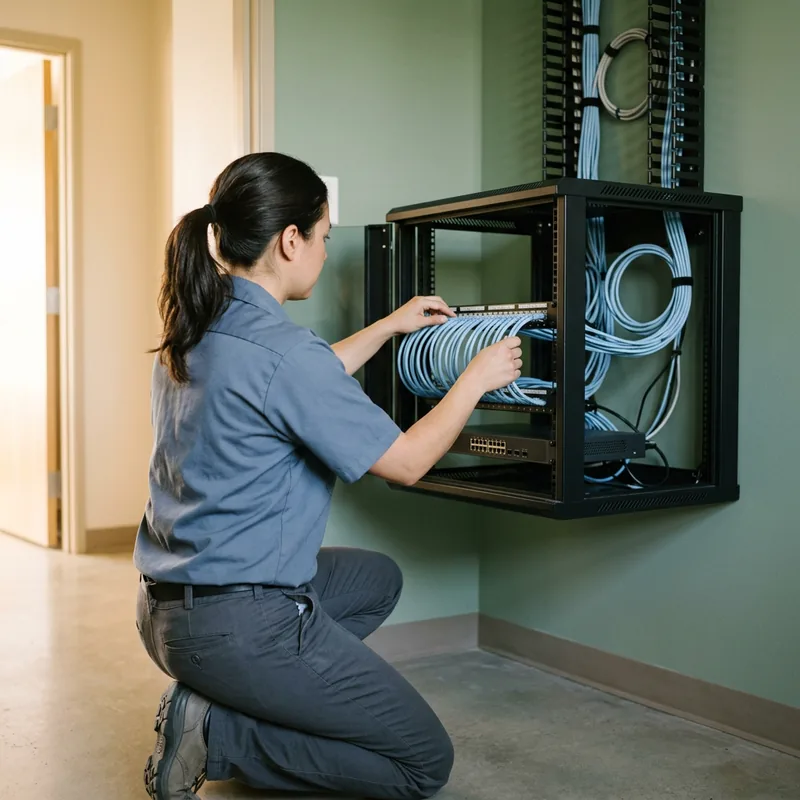
VJNetworks installs and configures business network equipment across Rockland, Westchester, and Bergen. We scope the drops, bring in a dedicated cabling contractor for the physical pull, then build the rack, configure the switches and firewall, place the wireless, patch it in, label it, and document it. It sits alongside the rest of the IT services we run for small businesses in the Tri-State area.
We don’t pull the wire. We build the network that runs on it.
Subcontracted, on purpose.
We used to run wire. We stopped. There are companies that do nothing but pull cable all day, and they are faster and cleaner at it than we were ever going to be.
So we bring one of them in, hand over the drop plan, and hold them to your move date. You still deal with us.
This is the work we actually do.
Switches, firewall, wireless access points, the patch panel work, network segmentation and addressing, the cutover, and the documentation. None of it is glamorous. That half decides whether the network is quick on a Monday morning and still fixable a year from now.
Nobody wakes up wanting cable. It comes up because you are moving, or taking the suite next door, or finally dealing with a closet that grew one cable at a time since 2011. What you actually need is for the whole thing to work on day one.
One walkthrough, one plan, one number to call when something is off.
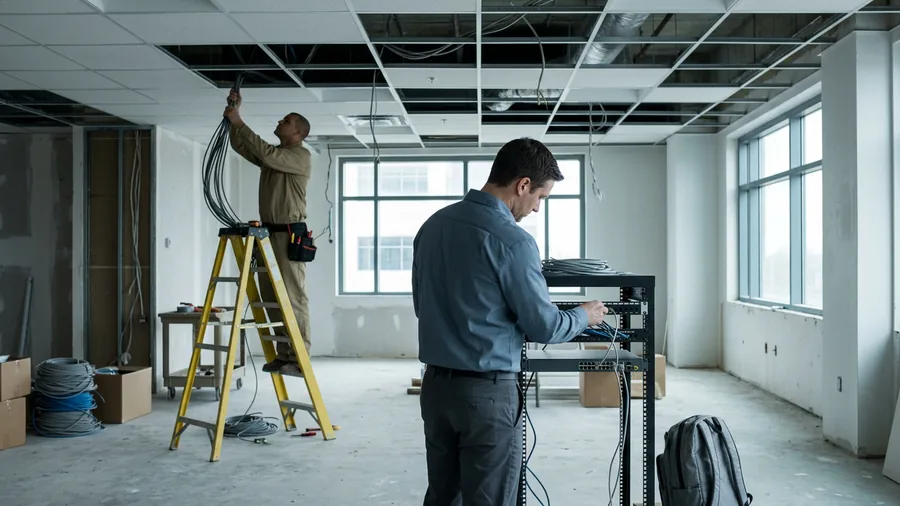
Almost nothing goes wrong with the cable. It goes wrong at the handoff.
The wire itself is close to a commodity. Most of what a cabling job costs is labor, and the labor number swings on things you can practically see from the parking lot, like whether the ceiling is open or hard lid, whether the suite is finished or still framed, and whether anyone has to work around your staff at seven in the morning.
That part is predictable.
The risky part is the afternoon the cabling crew coils their slack and drives off. Drops are in. Nothing is configured.
Somebody now has to decide what plugs where, how the network gets segmented, which ports carry power for the access points, and what happens to the old equipment at six on move night. If that person has not been in the room until then, that is the day a move slips. So we are there earlier.
The equipment side, start to finish.
Not every install needs all of it. Very few do. The walkthrough tells us which pieces apply before anyone puts a number on paper.
Drop Plan and Port Count
We walk the space and decide where the drops go, how many, and what each one is for. That happens first.
Rack and Patch Panel Build-Out
Wall-mount or floor rack, patch panels, cable management, and power, sized for the port count you have today plus enough room that the next round of hiring does not mean opening the wall again.
Switch Selection and Configuration
Managed switches sized to your port count and power load, then configured rather than dropped in as they shipped. Defaults are not a configuration.
Firewall Installation
The firewall installed and its rule set written around how your business actually works. Keeping it patched afterward is managed firewall service.
Wireless Access Point Placement
Access points placed for coverage instead of convenience, then tuned for channel and power once they are on the ceiling. Guesswork surfaces later.
Segmentation and Addressing
Guest Wi-Fi, staff devices, printers, and sensitive systems on separate segments instead of everything sharing one network. Flat networks age badly.
Power over Ethernet Budgeting
Power planned across access points, cameras, and phones so the switch carries the load you keep adding. Switches have a ceiling.
Labeling and As-Built Documentation
Every port labeled and a written record of what lives where. Least exciting item on this list, and the one that saves the most time later.
Moving, expanding, or building out a new suite?
Start with a walkthrough. We will tell you what the job really involves.
BOOK A WALKTHROUGH ↗︎Four stages, and only one of them lands on move night.
Walkthrough and Drop Plan
We walk the space with you, count drops, find the closet, and flag whatever is going to cost real money before it can surprise you.
Cabling Scheduled and Managed
We bring in the cabling contractor, hand over the plan, and hold the schedule. You approve one scope. Not two.
Staged and Configured First
Switches, firewall, and access points get configured before they reach your building. Move night is a bad time to be reading a manual.
Cutover, Then We Stay On It
Patch in, test, label, document. Then we are reachable through the week after, which is when the small stuff always surfaces.
Is this the right call for your build-out?
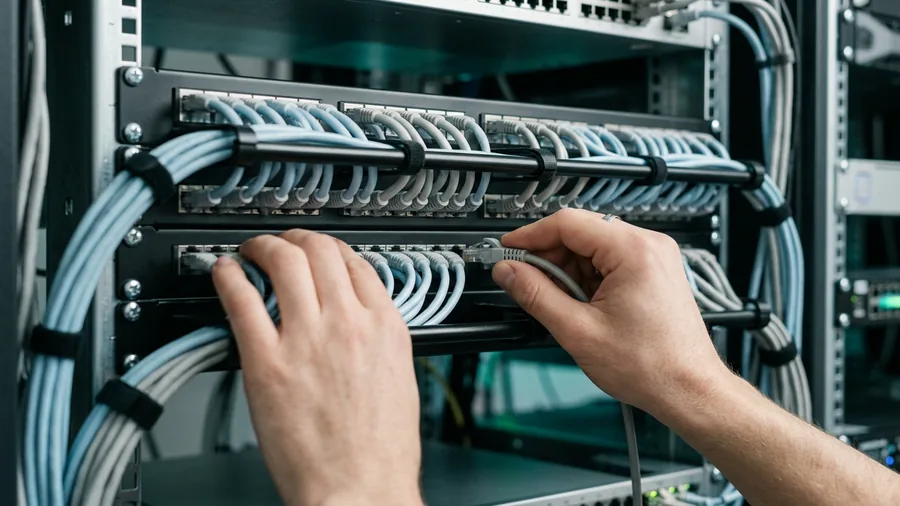
All you need is cable pulled and nothing configured. Call a cabling contractor directly. Keep the difference. We would tell you the same thing on the phone.
You have an internal network engineer already speccing the switches and the wireless. If they just want backup on the heavy weeks, co-managed IT is the better fit.
The site sits outside Rockland, Westchester, or Bergen. We scope this to buildings we can actually get to on the day it matters.
Twenty two years of walking into other people’s wiring closets.
Most installs turn into something longer. That is not a requirement.
Fair warning. A network installation is often how a relationship with us starts. We build the thing, it works, a few months pass, and the client would rather we just run it than keep calling somebody every time a switch port goes quiet.
That is the usual arc. It does not have to be.
You can hire us for the install and nothing beyond it. Everything gets documented and handed over clean, including to whoever supports you afterward. If you do want it run for you, our managed IT plans start at $995 a month, and the network we just built is already documented well enough to fold straight in.
About network installation and structured cabling.
Who handles network installation for small businesses in Rockland, Westchester, and Bergen?
VJNetworks installs and configures business network equipment across Rockland, Westchester, and Bergen. We size and configure the switches, firewall, and wireless, handle the patch panel work, and coordinate a dedicated cabling contractor for the physical cable pull. Twenty two years in the Tri-State area, 97% client retention.
Do you run the cable yourselves?
Not the physical pull, no. We used to run wire and we stopped, because there are companies that do nothing else and are quicker and neater at it than we would be. We bring one of them in, give them the drop plan, and manage the schedule against your date. The walkthrough, the equipment work, and the finished network stay with us.
What does a network installation cost?
Nobody can answer that honestly without standing in the space first. On the cabling side, labor drives the price far more than the cable itself does, and labor swings on pathway, ceiling type, and whether the suite is finished or still open. On the equipment side it comes down to port count, power load, and how many access points the floor plan really needs. Real number after the walkthrough.
Cat6 or Cat6A. Does the difference matter in a small office?
Often yes, and it is a cheap call to get right while the walls are still open. Cat6A leaves more headroom for faster links and handles the heat from Power over Ethernet better in tight bundles. Pulling cable a second time costs many times what the upgrade would have. We will tell you where the extra spend earns its keep and where it does not.
We move in six weeks. Is that enough time?
Usually, yes. What wrecks a timeline is almost never the cable. It is a landlord approval, a long-lead switch, or an internet circuit from the carrier that quietly eats thirty days, and any one of those can swallow your six weeks on its own. We check those first, because they are the ones you cannot compress later.
Can you work with the cabling company our landlord already uses?
Yes, and on a build-out that is common, so when a cabling contractor is already on the job we hand them the drop plan and coordinate with them directly instead of bringing our own crew in. What we will not do is assume somebody else has the configuration side covered. Nobody has. That is the gap we usually get called about.
Do we have to sign up for managed IT to get an installation?
No. Plenty of installs are one-time projects, documented well enough that another provider can pick them up without calling us. Most clients do end up staying, which is where our managed IT plans starting at $995 a month come in. It has never been a condition of doing the install.
Further reading: the Telecommunications Industry Association is the ANSI-accredited body behind the structured cabling standards installers work to. The Wi-Fi Alliance publishes what Wi-Fi CERTIFIED 7 actually covers, including 320 MHz channels in the 6 GHz band. Power over Ethernet across all four pairs was standardized in IEEE 802.3bt-2018, since folded into IEEE 802.3-2022.
Get the drop plan before you get the quote.
Twenty two years in the Tri-State area. 97% client retention. A free walkthrough that tells you what the job actually involves, including the parts that are going to cost you.